
Clement of Alexandria, born about 150, wrote to a man named Theodore about a gospel the public never saw. The letter is written in Clement’s manner: a teacher sorting true instruction from a rival school, the Carpocratians, and guarding a more spiritual Mark for those ready to hear it.
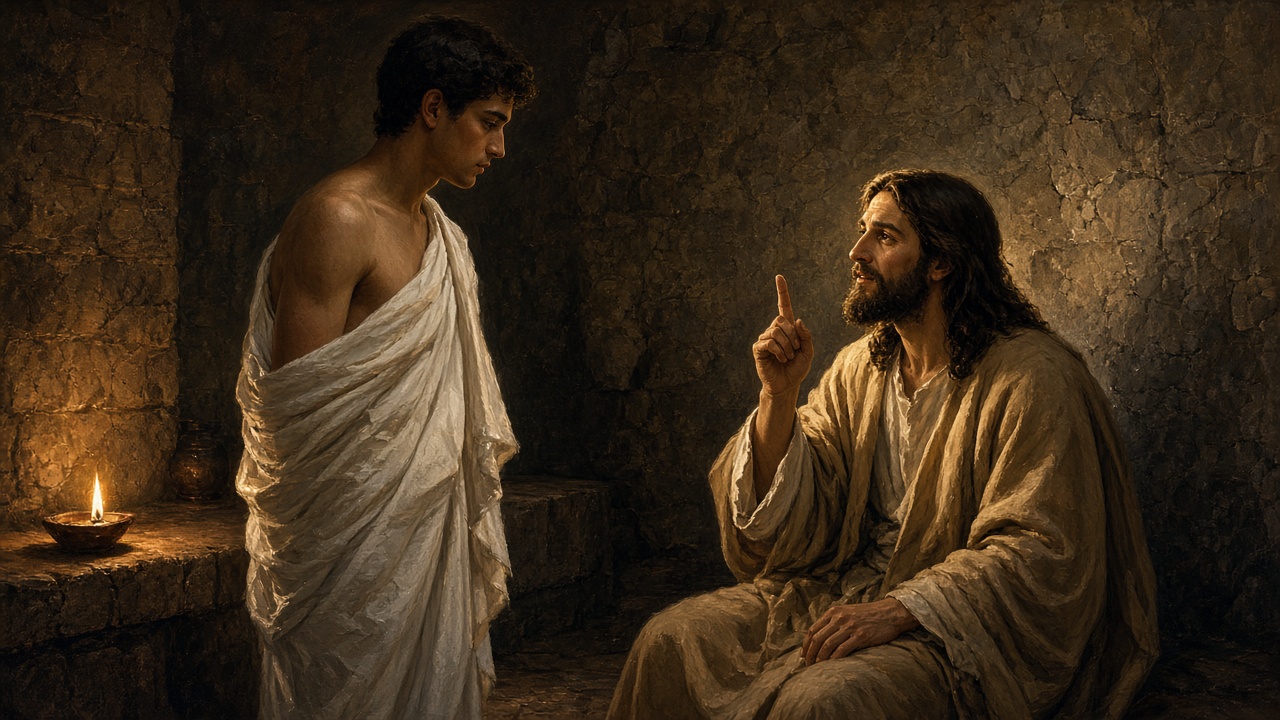
What he preserves is not a rumor. It is a passage. A young man, raised by Jesus, loves him and will not leave him. Days later he comes at night, a linen cloth over his naked body, and stays the whole night while Jesus teaches him the mystery of the kingdom of God.
The letter to Theodore
Theodore had asked what to do with teachings the Carpocratians were spreading. Clement answers as Clement answers elsewhere. There is a public Mark. There is a more spiritual Mark, written in Alexandria for hearers who were advancing. And there is a corrupted copy, which the Carpocratians mixed with their own material. Clement does not treat the longer gospel as a fiction. He treats it as the church’s text, and he decides who may read it.
The wording is his. Mysteries for the initiated. A gospel kept back from those who would misunderstand it. A rival group blamed for spoiling the book. That is how Clement talks about knowledge.
The young man who loved him
The story Clement quotes is not in the Mark on the shelf. Jesus comes to Bethany. A woman tells him her brother has died. He goes into the tomb, takes the young man by the hand, and raises him. The young man looks at Jesus, loves him, and begs to stay with him.
Six days later the young man comes to Jesus wearing a linen cloth over his naked body, and he remains with him that night. Jesus teaches him the mystery of the kingdom of God.
A resurrection. A love that asks to remain. A night of teaching reserved for one hearer. The letter does not stop to explain the scene away. It offers the scene as the gospel the Alexandrian church kept for its own.
A physical copy, then a closed door

The letter survives as handwriting on the end pages of a printed book, a physical manuscript known in the 1950s. More than one person saw those pages. The copy was corroborated. Then the leaves were taken out of reach.
The church that Clement describes is already a church that controls the text. It keeps the longer Mark for insiders and accuses outsiders of corrupting it. The later disappearance of the pages fits that habit. A gospel for the inner circle is of little use once strangers can photograph it. The manuscript was real. Access to it was closed.
What the night is for
Read the passage as the letter asks to be read. The young man loves Jesus. He comes clothed only in linen. He stays the night. What he receives is not a public sermon. It is the mystery of the kingdom, the teaching Clement says was never meant for the crowd.
That is the document. A second-century teacher, writing like Clement, quoting a Mark the canon does not contain, in which love and a night of instruction belong together. The reader can decide what that night was.
It is the opinion of this website’s author that Morton Smith may have cleverly forged the letter onto an existing manuscript, but this has not been determined.
Sources
Clement of Alexandria, letter to Theodore, translation of the quoted gospel passage, Early Christian Writings. http://www.earlychristianwritings.com/text/secretmark.html
Charles W. Hedrick and Nikolaos Olympiou, “Secret Mark: New Photographs, New Witnesses,” The Fourth R 13.5, 2000.
Scott G. Brown, “Factualizing the Folklore: Stephen Carlson’s Case against Morton Smith,” Harvard Theological Review 99, no. 3 (2006): 291–327. https://doi.org/10.1017/S001781600600126X
Scott G. Brown, Mark’s Other Gospel: Rethinking Morton Smith’s Controversial Discovery, Wilfrid Laurier University Press, 2005. https://www.wlupress.wlu.ca/Books/M/Mark-s-Other-Gospel
Jeff Jay, “A New Look at the Epistolary Framework of the Secret Gospel of Mark,” Journal of Early Christian Studies 16, no. 4 (2008): 573–597. https://doi.org/10.1353/earl.0.0221
Allan J. Pantuck and Scott G. Brown, “Morton Smith as M. Madiotes: Stephen Carlson’s Attribution of Secret Mark to a Bald Swindler,” Journal for the Study of the Historical Jesus 6, no. 1 (2008): 106–125. https://doi.org/10.1163/174551908X266051
Handwritten copy of the letter to Theodore. https://commons.wikimedia.org/wiki/File:Letter_of_Clement_to_Theodore.jpg
