We throw around the word “Christ” like it’s a family heirloom passed down through the carpentry shop in Nazareth—as if Mary and Joseph filled out a birth certificate for Jesus H. Christ.
Except “Christ” was never a last name. It was a job title. And the very first time the Hebrew Bible drops the word Mashiach (Messiah) in a political-theological blockbuster, it isn’t talking about a divine savior walking on water or a cosmic judge sitting on a throne.
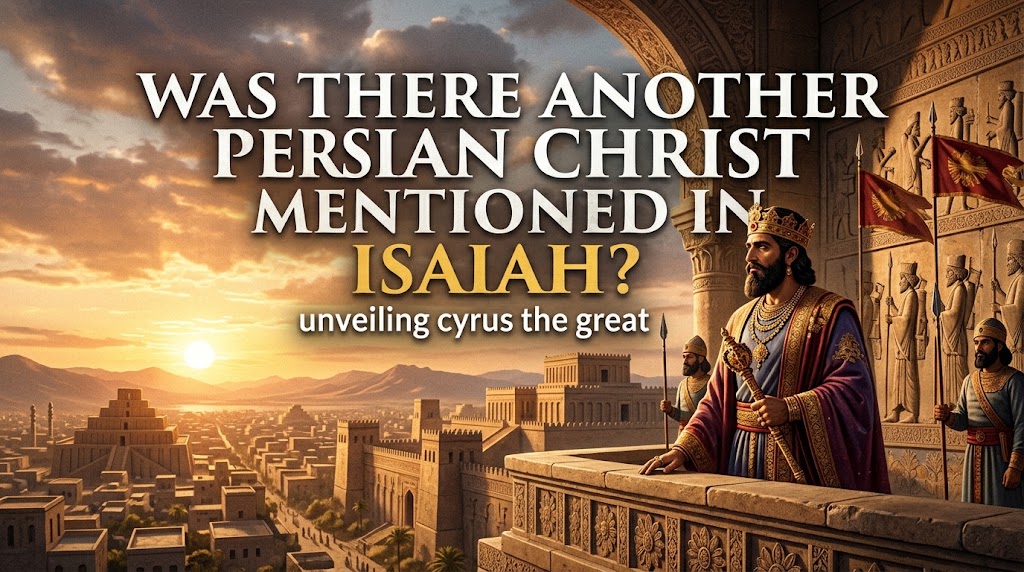
It’s talking about a pagan Persian king who didn’t even know Yahweh’s name: Cyrus the Great.
The Etymology Check: What Does “Christ” Actually Mean?
To understand why a Persian emperor gets slotted into biblical messianic history, you have to strip away centuries of stained-glass theology and look at the raw linguistics.
- The Hebrew: Mashiach literally means “anointed one”—someone smeared or rubbed with sacred oil. In ancient Israelite culture, this wasn’t reserved for some distant cosmic figure. Anyone tapped for a heavy-duty state job by divine authority got anointed: high priests, ruling monarchs, and even foreign potentates.
- The Greek Translation: When Jewish scholars translated the Hebrew Bible into Greek (the Septuagint) centuries before the Common Era, they translated mashiach as Christos.
So, when the New Testament refers to “Jesus the Christ,” it isn’t shouting out a surname. It’s making a radical, explosive political claim: This is the true anointed king.
The Isaiah 45 Shock
Which brings us right back to the Book of Isaiah. In Isaiah 45:1, the text records a jaw-dropping divine decree:
“Thus says the LORD to his anointed, to Cyrus, whose right hand I have grasped, to subdue nations before him and to strip kings of their armor, to open doors before him that gates may not be closed…”
Look closely at that translation. The word translated as “anointed” is mashiach. God is explicitly calling the pagan King of Persia His messiah.
The historical backdrop makes it even wilder. By the time Isaiah is written, the Kingdom of Judah has collapsed, Jerusalem is in ruins, and the elite are shivering in exile in Babylon. Then comes Cyrus. In 539 BCE, the Persian juggernaut sweeps through Mesopotamia, shatters the Babylonian Empire, and does something unprecedented for an ancient conqueror: he lets displaced populations go home and restores cult objects (policies reflected on the Cyrus Cylinder). The biblical account of temple rebuilding funds is in Ezra 1 and 6, not on the Cylinder itself.
To the exiled Israelites staring at the rubble of their geopolitical reality, this foreign king wasn’t just a lucky break—he was their deliverer. He was the instrument of liberation. He was, by strict scriptural definition, their anointed.
Why It Matters
When we treat “Christ” as a last name, we flatten history. We turn an ancient, punchy, politically charged royal title into a static piece of religious jargon.
The Book of Isaiah reminds us that long before the first-century Mediterranean was buzzing with messianic expectations, the original “Christ” of the Hebrew text was a bearded Achaemenid emperor running a multi-ethnic super-state from Persepolis. History is rarely a clean Sunday school lesson; it’s a messy, fascinating collision of empires, geopolitical muscle, and the theological vocabulary used to make sense of it all.
References & Scholarly Works
- JPS Tanakh (NJPS) — Standard scholarly Jewish Publication Society translation; useful for Isaiah 45:1 and mashiach in exilic/post-exilic contexts. (Not to be confused with Robert Alter’s The Hebrew Bible: A Translation with Commentary.)
- Livius.org: Cyrus Cylinder Translation — Primary historical documentation of Cyrus the Great’s administrative and religious policies toward conquered populations in Mesopotamia.
- Joseph Blenkinsopp, Isaiah 40–55 (Anchor Yale Bible 19A) — In-depth academic commentary exploring the theological framework of Second Isaiah, foreign rulers as divine agents, and Persian imperial propaganda.