The Virgin Birth, the Missing DNA, Two Contradictory Family Trees, and Christianity’s 2,000-Year-Old Paternity Problem
Christianity has a family problem.
Not a small problem. Not an embarrassing uncle at Thanksgiving problem. A foundational, theological, potentially Messiah-disqualifying problem hiding in the very first chapter of the New Testament.
According to Christian doctrine, Jesus Christ must satisfy two extraordinary claims.
First, he must be descended from King David, fulfilling the Jewish expectation of a royal Messiah whose ancestry connects him to Israel’s greatest dynasty.
Second, he must be born of a virgin, conceived through the Holy Spirit without a human biological father.
There’s just one awkward detail.
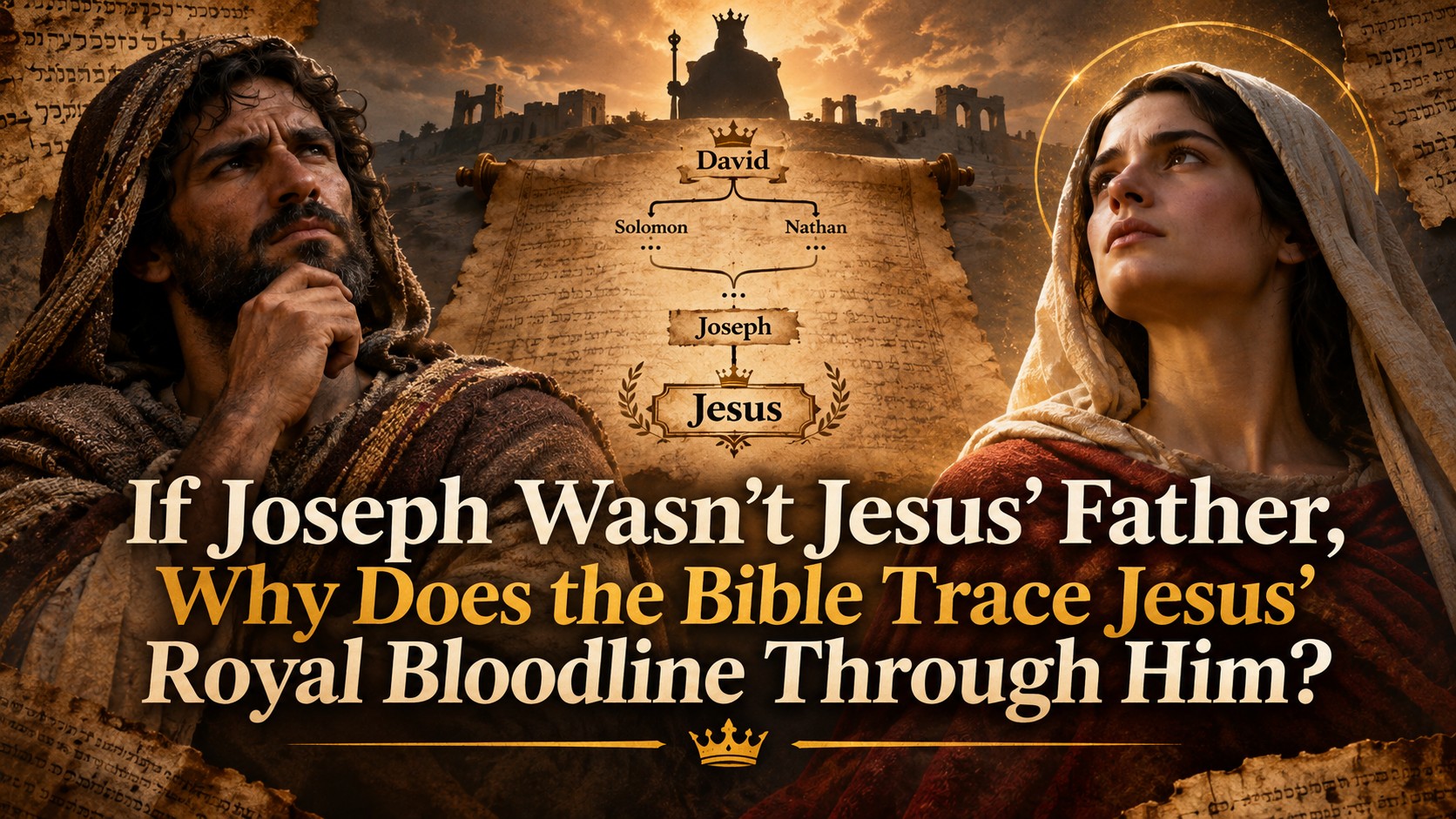
Both New Testament genealogies trace Jesus’ supposed royal ancestry through Joseph. The same Joseph whom the Gospels insist did not father Jesus.
Think about that.
Christianity spends two elaborate genealogies establishing Jesus’ royal credentials through a man whom its own miraculous birth narratives remove from the biological equation.
It’s rather like presenting a DNA test proving you’re descended from Napoleon, then explaining that the man whose DNA you tested isn’t actually related to you.
And just when you think the genealogical problem couldn’t get any stranger, Matthew and Luke disagree about who Joseph’s father was.
Welcome to one of Christianity’s most fascinating theological contradictions, where ancient Jewish expectations, Greek translations, competing Gospel traditions, and centuries of apologetics collide.
The question isn’t simply whether God could cause a virgin to conceive. An omnipotent deity, by definition, could do extraordinary things.
The historical question is considerably more uncomfortable:
Why would the supposedly divinely inspired authors of the Gospels establish Jesus’ messianic legitimacy using genealogies that seem to undermine the miraculous conception they simultaneously demand we believe?
And what might this reveal about how Christianity’s most familiar stories actually developed?
1. The Messiah needed an ancestry, not merely a miracle
Long before Christianity existed, Jewish scripture contained promises concerning the descendants of David.
In 2 Samuel 7:12–16, God promises David an enduring dynasty. Jeremiah 23:5–6 anticipates a righteous branch raised up for David. Isaiah 11:1speaks of a shoot emerging from Jesse’s family.
These passages became important foundations for Jewish and Christian messianic interpretation.
The expectation was not uniformly understood across ancient Judaism. Different Jewish groups anticipated different deliverers, including royal, priestly, and heavenly figures. Nevertheless, the image of a Davidic king became particularly influential.
The royal Messiah was expected to emerge from David’s lineage.
Not simply admire David.
Not merely inherit his personality.
Not obtain a ceremonial certificate of honorary Davidic membership.
The language of biblical royal succession concerns ancestry and dynasty.
Jeremiah 23:5describes a righteous branch associated with David. In its ordinary historical setting, this means the restoration of David’s royal family.
And Paul, writing decades before Matthew and Luke, makes the ancestry explicit.
Romans 1:3describes Jesus as coming from the seed of David according to the flesh.
That expression matters.
Paul’s Greek wording, ek spermatos Dauid kata sarka, naturally conveys physical descent. The phrase does not require a modern genetic theory, but it does sound considerably more biological than honorary or adoptive membership.
This is among the earliest surviving Christian descriptions of Jesus’ ancestry.
Now compare Paul’s claim with the later infancy narratives.
If Jesus was biologically descended from David through Joseph, the royal lineage makes straightforward sense.
But if Joseph contributed nothing to Jesus’ conception, Joseph’s biological descent cannot by itself establish Jesus’ biological descent.
There are possible theological answers to that problem.
But the problem exists because the New Testament supplies both claims without clearly explaining how they fit together.
And the deeper we investigate, the less this resembles one coherent biography and the more it resembles several inherited traditions struggling to occupy the same story.
2. Matthew builds a royal family tree—and then cuts off the last branch
Open the New Testament to Matthew 1.
Before we hear about Bethlehem, angels, wise men, or miraculous pregnancies, we encounter a long genealogy.
Matthew begins by identifying Jesus as the son of David and the son of Abraham.
He then traces a lineage through Abraham, Isaac, Jacob, Judah, David, Solomon, and successive generations until arriving at Joseph.
For most of the genealogy, Matthew follows a repeated pattern: one man fathers the next.
It is a carefully constructed chain of ancestry, designed to demonstrate continuity between Jesus and Israel’s foundational history.
Then something remarkable happens.
Matthew 1:16reaches Joseph.
And suddenly the grammatical pattern changes.
Instead of saying Joseph fathered Jesus, Matthew identifies Joseph as Mary’s husband and describes Jesus as born from Mary.
In Greek, the relative pronoun referring to the person from whom Jesus was born is feminine. It points to Mary, not Joseph.
This is not an accidental feature of English translation. It is part of Matthew’s Greek text.
Matthew has spent fifteen verses establishing a father-to-son lineage, only to abandon that pattern at precisely the point where it matters most. Bible Gateway +1
Then Matthew 1:18–25 explains that Mary became pregnant through the Holy Spirit before she and Joseph came together.
Joseph is explicitly removed from biological paternity.
So what exactly has Matthew demonstrated?
That Joseph descends from David.
Excellent.
But the person whose messianic eligibility Matthew wants to establish is Jesus.
And according to Matthew’s own story, Joseph didn’t biologically father him.
The genealogy is not necessarily meaningless: in Matthew’s narrative, Joseph accepts Mary, takes responsibility for Jesus, and names the child. These actions can support an interpretation involving legal fatherhood.
But Matthew has not clearly demonstrated biological Davidic descent through Joseph.
He has demonstrated the ancestry of the man married to Jesus’ mother.
The genealogy arrives at the wrong biological father because the story itself says there is no biological father in Joseph’s place.
This is the central tension. It doesn’t disappear simply because generations of Christians have become accustomed to reading past it.
3. Luke produces another family tree—and gives Joseph a different father
Perhaps Luke will settle the matter.
After all, Luke also tells the story of a virginal conception. And he provides another lengthy genealogy.
Unfortunately, Luke appears to have consulted a remarkably different set of family records.
Compare the two accounts:
| Question | Matthew | Luke |
|---|---|---|
| Joseph’s father | Jacob (Matthew 1:16) | Heli (Luke 3:23) |
| Davidic branch | Solomon | Nathan |
| Direction | Abraham to Jesus | Jesus back to Adam |
| Immediate purpose | Royal and Abrahamic ancestry | Universal human ancestry |
| Biological paternity | Joseph excluded by infancy narrative | Joseph treated as Jesus’ presumed father |
The differences are not limited to a few spellings.
Matthew and Luke follow strikingly different routes from David to Joseph. They converge on several important ancestral figures but disagree across much of the intervening genealogy.
Both accounts reach Joseph. Neither explicitly identifies its genealogy as Mary’s family tree. Charting the New Testament +1
One of the most frequently offered Christian explanations is that Matthew records Joseph’s ancestry while Luke actually records Mary’s.
That would be convenient.
It would also be a lot more convincing if Luke said it.
He doesn’t.
Luke 3:23identifies Jesus as the supposed son of Joseph and continues the genealogical list through Heli.
Mary is not named as the person whose ancestors are being recorded.
Supporters of the Marian-genealogy interpretation propose that Heli may have been Joseph’s father-in-law, making Luke’s genealogy a maternal line expressed through Joseph.
It is not an impossible historical reconstruction.
But it is an inference supplied to reconcile two accounts, not an explanation clearly stated in Luke.
Other interpreters propose different forms of legal and biological genealogy, including levirate marriage arrangements that could give Joseph two fathers in different senses.
Again, these are possibilities rather than established historical facts.
A serious historical investigation must distinguish what the ancient texts actually say from what later interpreters need them to say.
And here the discrepancy is undeniable:
Matthew names Jacob. Luke names Heli. Both are presented in the context of Joseph’s ancestry.
The authors also have distinct theological interests.
Matthew connects Jesus to Abraham and Israel’s monarchy.
Luke extends the family line all the way back to Adam, eventually identifying Adam as God’s son.
These are not neutral, independently verified birth certificates. They are literary genealogies embedded in theological narratives.
Their structures reveal what their authors wanted to communicate about Jesus.
Whether either author possessed authentic family records reaching back a thousand years is another question entirely.
4. The two escape routes: Mary and adoption
Christian apologetics has spent centuries trying to reconcile the virgin birth with Davidic descent.
Two explanations deserve serious attention.
The first is that Jesus inherited Davidic ancestry biologically through Mary.
The second is that Joseph transmitted Davidic status legally through adoption or acknowledged fatherhood.
Neither should be dismissed as logically impossible.
But neither establishes the claim as a historical fact.
The Mary solution
Mary could theoretically have been descended from David.
A person does not need a biological father from a particular lineage if their biological mother is descended from that lineage.
This means the headline claim that virgin birth and Davidic descent are absolutely incompatible would go too far.
However, this solution encounters an obvious evidentiary problem.
Where is Mary’s genealogy?
Matthew doesn’t provide it.
Luke doesn’t explicitly provide it.
Luke 1:27associates Joseph with the house of David, while Luke 1:36identifies Elizabeth as Mary’s relative. Earlier, Luke 1:5describes Elizabeth as descended from Aaron.
None of that establishes Mary’s complete royal ancestry.
Some Christian interpreters argue that Luke’s genealogy secretly supplies the missing information, but the text itself never announces such a switch.
Mary might have been a descendant of David. The Gospels simply do not demonstrate it through a clearly identified maternal genealogy.
The possibility cannot be converted into documented fact by repetition.
The adoption solution
The adoption argument is more interesting.
Joseph may have been understood as establishing Jesus’ legal membership in the Davidic family through his recognition of the child.
This has genuine scholarly defenders.
Caleb T. Friedeman, writing in New Testament Studies in 2020, argues that early Jewish culture did have concepts and practices of adoption capable of helping explain the Gospel narratives. His research challenges the assertion that an adoption solution necessarily requires importing Roman legal customs. Cambridge University Press
This matters because a fair skeptical critique must address the strongest available Christian response.
Yet questions remain.
Did every relevant interpretation of Davidic messiahship accept adoption as sufficient for royal descent?
Did first-century Jews recognize a universally applicable mechanism by which Joseph’s acknowledgment would establish the particular messianic succession being claimed?
And would that legal relationship satisfy the language of bodily descent found in Romans 1:3?
These questions are not answered simply by proving that Jewish adoption practices existed.
The adoption interpretation may explain how early Christians understood Jesus as belonging to Joseph’s family without Joseph being his biological father.
It does not automatically establish biological descent from David, nor does it resolve the conflict between Matthew’s and Luke’s ancestral lists.
Most importantly, it requires us to distinguish between three claims that are often quietly merged into one:
Jesus was biologically descended from David.
Jesus was legally affiliated with a Davidic household.
Jesus was the Messiah because Christians understood him as fulfilling Davidic expectations.
Those are different propositions.
And proving one does not automatically prove the others.
5. The earliest Gospel doesn’t even mention the virgin birth
Now the story takes a particularly interesting turn.
Most scholars studying the Synoptic Gospels accept some form of Markan priority: the conclusion that Mark was written before Matthew and Luke and subsequently served as an important literary source for both.
The conventional approximate dates are:
- Paul’s undisputed letters: AD 50–60.
- Mark: around AD 65–75.
- Matthew: around AD 80–90.
- Luke: around AD 80–100.
These dates are scholarly estimates, not dates printed on the original manuscripts. OUP Academic +1
Under this reconstruction, the virgin birth narratives appear in later surviving Gospel accounts, not the earliest one.
Mark starts with the adult Jesus.
No Bethlehem.
No virgin Mary visited by an angel.
No Joseph pondering a miraculous pregnancy.
No genealogy proving Davidic ancestry.
No explanation of an extraordinary conception.
Mark begins with John the Baptist, then introduces Jesus as an adult whose public ministry is just beginning.
Of course, silence does not prove ignorance. Mark could have known a virgin-birth tradition and simply chosen not to include it.
But some of Mark’s passages become especially intriguing when compared with later Christian theology.
In Mark 3:21, Jesus’ family or associates, depending on how the Greek reference is understood, attempt to restrain him because people are saying he is out of his mind.
Later, in Mark 6:3, Jesus is identified by local people as Mary’s son, with brothers and sisters.
Mark’s presentation does not resemble a narrative in which everyone in Jesus’ immediate circle has been carefully instructed about the extraordinary circumstances of his conception.
Imagine Mary having personally received an angelic announcement that her child would possess a unique divine identity.
Imagine Joseph being told that Mary’s pregnancy was the work of the Holy Spirit.
Then imagine the family reacting to Jesus’ extraordinary religious behavior as though something might be wrong with him.
There are ways to reconcile those stories. People may doubt even what they once believed, and miraculous announcements need not prevent later confusion.
But from a literary-historical perspective, the contrast raises a legitimate question:
Are we seeing consistent memories of a single family, or different Christian authors constructing different pictures of Jesus?
Mark does not need to know a virgin birth for his story to work.
Matthew and Luke, however, make extraordinary conceptions central to their opening chapters.
The difference is significant.
It becomes more significant when we consider Paul.
6. Paul knew about Jesus’ fleshly ancestry—but said nothing about a virgin
Paul’s authentic letters are our earliest surviving substantial Christian writings.
And when Paul refers to Jesus’ human origins, two passages deserve particular attention.
Romans 1:3identifies Jesus as descended from David according to the flesh.
Galatians 4:4describes God sending his Son, born of a woman and born under the law.
Neither passage mentions a virginal conception.
Paul does not identify Joseph as Jesus’ father. Nor does he explicitly reject the possibility of a miraculous birth.
That distinction is important.
But the combination is revealing.
The earliest surviving Christian author can discuss Jesus’ ancestry, divine sonship, birth, and theological significance without presenting the extraordinary conception that later becomes so important to Christianity.
If Paul’s understanding of Jesus included the virgin birth, he leaves us without an explicit statement of it.
That is hardly proof Paul denied the doctrine.
Nevertheless, it prevents us from confidently projecting Matthew’s and Luke’s birth narratives backward into the earliest Christian generation.
Romans 1:3is especially difficult to ignore.
Paul’s emphasis on Davidic descent according to the flesh sounds like a tradition emphasizing Jesus’ ordinary human ancestry alongside his exalted status.
A plausible scholarly reconstruction is that early Christians already associated Jesus with David and that later authors developed distinct explanations of his origins.
This is not the only possible reconstruction.
But it requires fewer unrecorded family relationships than supposing that Paul, Mark, Matthew, and Luke all possessed identical detailed knowledge of Jesus’ miraculous conception yet expressed it in markedly different ways.
Perhaps the Davidic Messiah came first in Christian tradition, and the virgin-born Messiah came later.
If so, Christianity inherited two claims that subsequent theologians would spend centuries trying to reconcile.
7. Did a Greek translation help create the virgin birth?
The genealogical problem becomes even more interesting when we examine the biblical passage Matthew uses to justify the miraculous conception.
Matthew 1:22–23 appeals to Isaiah 7:14.
In Christian tradition, this becomes one of the foundational prophecies of Jesus’ virgin birth.
But the original Hebrew text presents an important linguistic problem.
The Hebrew word in Isaiah 7:14is almah.
It ordinarily designates a young woman of marriageable age. It does not, by itself, explicitly establish that the woman has never had sexual intercourse.
The ancient Greek Septuagint translated this word as parthenos, a term that can convey virginity.
Matthew quotes the Greek form and applies it to Mary.
This opens the possibility that a Greek translation played an important role in the development or formulation of the Christian virgin-birth tradition.
Robert R. Cargill, writing through the University of Iowa’s Bible & Archaeology project, discusses precisely how the Septuagint made Matthew’s interpretation possible. The crucial scholarly distinction is between demonstrating that Matthew relied on the Greek translation and demonstrating that the entire virgin-birth story originated from it. The former is well supported; the latter remains a hypothesis. The University of Iowa +1
But there’s another problem.
Read Isaiah 7 in context.
Isaiah is addressing events involving King Ahaz and a political crisis in the eighth century BCE.
The child functions as a sign connected to the historical circumstances of that period.
Isaiah 7:15–16 discusses what will happen before the child grows old enough to distinguish good from evil.
That time frame belongs to the ancient political situation being addressed.
It is not naturally a prediction awaiting fulfillment seven centuries later.
Matthew reads the passage through a Christian theological framework, transforming an ancient sign into a prophecy about Jesus.
This resembles a broader practice in early Christian literature: interpreting Jewish scripture as containing hidden patterns and fulfillments revealed through Christ.
Such interpretation may be meaningful within Christian faith.
But meaning within a religious tradition is not the same thing as evidence that the Hebrew author originally intended to predict a virgin birth hundreds of years in the future.
And that distinction is devastating to simplistic claims that Isaiah straightforwardly predicted Mary’s miraculous pregnancy.
The historical question becomes:
Did Matthew possess independent knowledge of a virgin birth and find a scripture that explained it?
Or did his interpretation of scripture contribute to the formation of the story itself?
We cannot establish the answer with certainty.
But the latter possibility deserves serious consideration.
8. Two birth stories, two different histories, and one very suspicious destination
Matthew and Luke agree that Jesus was born in Bethlehem.
They agree on Mary, Joseph, and an extraordinary conception.
Yet their narratives differ dramatically in the events surrounding the birth.
Matthew introduces visiting magi, Herod’s murderous intentions, the family’s flight into Egypt, and its eventual settlement in Nazareth.
Luke introduces a Roman census, shepherds, angelic announcements, and the family’s journey from Nazareth to Bethlehem.
The famous Christmas pageant combines these details into one continuous narrative.
But the individual Gospels tell different stories.
In Matthew, Bethlehem appears to be the family’s initial home, and Nazareth becomes their destination after returning from Egypt.
In Luke, Nazareth is the family’s home before the birth, and a census provides the reason for traveling to Bethlehem.
The historical difficulty becomes particularly severe when Luke associates Jesus’ birth with Quirinius’ census.
Herod the Great died around 4 BCE.
The well-attested census associated with Quirinius occurred in AD 6.
That is approximately a decade apart.
Christian scholars have proposed alternative chronologies and translations, but the chronological tension remains a substantial issue in historical scholarship. Boston College’s theological resources acknowledge the discrepancy, while Oxford’s academic literature documents the continuing debate. OUP Academic +1
And here’s why it matters to the question of Jesus’ ancestry.
Bethlehem was associated with David.
Micah 5:2became important to Christian interpretation of the Messiah’s origins.
Both Matthew and Luke place Jesus in Bethlehem, but they use remarkably different narrative machinery to accomplish it.
For the historical critic, this raises the possibility that theological expectations influenced the construction of the birth narratives.
Jesus was widely identified with Nazareth.
But the Messiah was expected, in an influential interpretation of Jewish scripture, to be connected to David’s city.
So the later Gospel stories independently find ways to place his birth there.
Was Bethlehem a remembered historical birthplace?
Or was Bethlehem a theological destination that the stories were constructed to reach?
Neither possibility can be settled merely by pointing out that both authors name the same town.
Two authors can share a religious expectation without sharing independently verified historical information.
The same issue applies to their genealogies.
Both authors want Jesus connected to David.
Their accounts disagree on how that ancestry is traced.
And both simultaneously deny Joseph’s biological role in Jesus’ conception.
We are left with a remarkable pattern:
The destination agrees. The routes disagree. The documents disagree. The biological connection remains unexplained.
If these were modern genealogical records submitted to establish inheritance rights, we would have some serious questions for the attorneys.
9. What biblical source criticism reveals about this problem
The genealogical controversy is not simply a case of skeptical readers hunting for mistakes.
It belongs to the larger field of historical-critical biblical scholarship.
For centuries, scholars have examined the Bible as a collection of ancient writings composed, transmitted, edited, and interpreted within changing historical communities.
The documentary hypothesis, traditionally associated with the Pentateuch, proposes that portions of the Torah developed through the combination of distinct literary sources.
Its classic formulation involves sources commonly designated J, E, D, and P, although contemporary Pentateuchal scholarship includes competing and substantially revised models.
The documentary hypothesis is not a theory explaining the composition of Matthew and Luke. Its direct subject is the Torah. OUP Academic
The relevant parallel is methodological.
Biblical books can preserve traditions that originated in different historical settings.
Editors and authors can combine materials that reflect different assumptions or theological goals.
When separate traditions are brought together, tensions may remain.
The Synoptic Problem applies comparable questions of literary relationships to Matthew, Mark, and Luke.
Under the widely accepted Markan-priority model, Matthew and Luke used Mark and supplemented his narrative with other material.
Their infancy narratives are especially important because Mark lacks a corresponding account.
Scholars consequently examine Matthew 1–2 and Luke 1–2 as distinct compositions, rather than assuming that every incident in one account must be silently inserted into the other.
This changes how we interpret their discrepancies.
Instead of asking, “How can we invent a sequence of events that makes every detail fit?” historians ask:
What sources did the authors use?
What traditions were available?
What did their audiences believe?
What scriptures shaped their narratives?
What theological claims were the authors trying to establish?
And how much independent historical information can reasonably be recovered?
When these questions are applied to Jesus’ ancestry, the genealogies become evidence of early Christian interpretation and identity construction, even if their historical accuracy remains uncertain.
That does not mean the authors consciously fabricated everything.
Ancient writers frequently combined received traditions, interpretive conventions, and theological purposes without operating according to modern historical standards.
But it does mean that theological intention cannot be mistaken for historical verification.
10. Does Jesus mythicism explain the contradictions?
A more radical skeptical theory proposes that Jesus never existed as a historical individual.
This position is commonly called Christ mythicism.
Some mythicist theories interpret Jesus as a celestial or mythological savior whose earthly biography developed through scriptural interpretation and narrative elaboration.
From such a perspective, competing genealogies and miraculous birth stories might be regarded as stages in the construction of a literary figure.
There is an obvious attraction to that explanation.
If early Christians were developing a sacred narrative rather than preserving a documented biography, disagreement over ancestry would be unsurprising.
However, the distinction between a mythologized historical person and an entirely fictional person is crucial.
Most specialists in early Christianity and the historical Jesus accept that Jesus existed.
Justin J. Meggitt’s scholarly examination of mythicism acknowledges the overwhelming prevalence of that conclusion while arguing that the debate itself deserves serious intellectual scrutiny. Simon Gathercole has likewise argued that Paul’s letters provide strong evidence against the claim that Jesus was entirely mythical. Cambridge University Press +1
The contradictions in Matthew and Luke do not prove that Jesus was invented.
Historical people routinely accumulate legends.
Real rulers acquire supernatural ancestry.
Real religious leaders become subjects of miraculous stories.
Real figures are retroactively connected to prestigious families.
One does not need a fictional Jesus to explain the possibility of fictionalized genealogies or birth traditions.
Indeed, a historically Jewish preacher later interpreted as the Davidic Messiah could provide a plausible setting in which increasingly elaborate claims about his origins emerged.
From a skeptical historical standpoint, this distinction actually strengthens the argument.
We do not have to disprove Jesus’ existence to question the accuracy of stories written about his conception.
We do not have to explain every aspect of Christianity as a myth to recognize mythmaking within Christianity.
And we do not have to claim that Matthew and Luke deliberately lied to acknowledge that their narratives contain unresolved historical and literary difficulties.
The questions remain whether these particular stories accurately preserve events and whether their claims can be independently substantiated.
11. Could Jesus have had an ordinary biological father?
There is one possibility that dramatically simplifies the entire genealogical problem.
Suppose Jesus was conceived through ordinary human reproduction.
Suppose Joseph was his biological father.
Under that scenario, a genuinely Davidic Joseph could have transmitted biological Davidic ancestry to Jesus.
Paul’s reference to descent according to the flesh would make straightforward sense.
Joseph’s genealogical importance would be obvious.
And the later virgin-birth narratives could reflect theological developments concerning Jesus’ divine identity.
There would still be the problem of Matthew and Luke supplying conflicting genealogies, but the basic biological relationship would no longer be mysterious.
Does this demonstrate that Joseph fathered Jesus?
No.
We possess no ancient DNA evidence, no independent birth record, and no reliable means of identifying Jesus’ biological father with certainty.
Nor should the historical possibility of ordinary conception be confused with a claim that Mary was sexually unfaithful. An ordinary birth within a family requires no scandal.
What it illustrates is how the virgin-birth claim introduces a complication that does not arise if Joseph is treated as Jesus’ biological father.
Under the historical-critical approach, extraordinary conception stories are not accepted as established historical events merely because ancient religious authors recorded them.
They must be evaluated as ancient claims.
And the documentary evidence for the virgin birth consists primarily of the narratives in Matthew and Luke, with later Christian belief and interpretation building upon them.
No independent contemporary record verifies the event.
That is not mathematical proof that it never happened.
It is a substantial reason historians cannot establish it as a historical fact.
The biological solution is simple.
The theological solution is elaborate.
That difference does not prove the simpler reconstruction is correct, but it helps explain why critical historians do not begin by assuming that every miraculous claim must be preserved at all costs.
12. The question Christians should actually be asking
The strongest Christian response is not that the two claims are logically incompatible.
They aren’t necessarily.
Mary could have descended from David.
Joseph could have conferred recognized familial status.
Ancient concepts of ancestry, inheritance, legal fatherhood, and messianic legitimacy were more varied than modern DNA-based assumptions.
The strongest Christian argument is that early believers understood Davidic identity in a way that could accommodate Jesus’ unusual conception.
But that is not the same as demonstrating that Matthew and Luke provide historically reliable biological genealogies.
And this exposes the larger problem.
Christians are frequently taught to treat the Bible as one coherent divine revelation.
Yet its earliest surviving writings emphasize different aspects of Jesus’ origins.
Paul describes Davidic descent according to the flesh without mentioning a virgin birth.
Mark begins with the adult Jesus and supplies neither infancy narrative nor genealogy.
Matthew presents a carefully arranged royal genealogy through Joseph, then explicitly excludes Joseph from biological paternity.
Luke supplies a different ancestry, names a different father for Joseph, and introduces a separate account of the circumstances surrounding Jesus’ birth.
These documents do not speak with one uncomplicated narrative voice.
They preserve developing and sometimes competing ways of explaining who Jesus was.
That conclusion does not require hostility toward Christians.
It requires taking their scriptures seriously enough to read each author on his own terms.
The discomfort comes when believers insist that the texts must agree before examining whether they actually do.
13. The ultimate irony: Joseph is essential until he isn’t
Consider the strange role Joseph plays in the Christian story.
To establish Jesus’ royal ancestry, Joseph is indispensable.
Matthew needs his family tree.
Luke needs his family tree.
Joseph’s connection to David matters enormously.
But to establish Jesus’ divine conception, Joseph must suddenly become biologically irrelevant.
He is important enough to establish the pedigree.
Not important enough to provide the paternal DNA.
He must be Jesus’ father for the purposes of family identity, but not his father for the purposes of conception.
For Christians who interpret fatherhood and lineage legally, that arrangement can make theological sense.
But the biblical accounts do not supply an agreed, explicit explanation proving that such legal fatherhood satisfies every relevant claim about Davidic descent.
And they certainly do not provide a clear maternal genealogy to remove the ambiguity.
Instead, later interpreters must reconstruct relationships and legal mechanisms that the Gospel writers left unexplained.
The irony is extraordinary.
Christianity’s most famous miracle removes the very biological connection that its most elaborate genealogies appear designed to establish.
If Joseph was Jesus’ biological father, the virgin-birth doctrine becomes false.
If Joseph was not his biological father, Joseph’s genealogy alone cannot prove Jesus’ biological descent from David.
If Mary carried the Davidic ancestry, the Gospels fail to demonstrate that through an explicitly maternal genealogy.
And if Joseph passed on Davidic status by adoption or legal acknowledgment, Christians must explain why that satisfies the particular messianic expectations and language of physical descent invoked in support of Jesus’ identity.
Every solution comes with historical questions.
Some may be theologically persuasive.
None establishes a fully documented, contradiction-free family history.
Conclusion: The miracle that complicated the Messiah
The virgin birth has become such a familiar element of Christianity that many believers never notice the genealogical difficulty sitting beside it.
Christmas presents a harmonious story.
The Gospels present something considerably more complicated.
Two family trees.
Two different fathers for Joseph.
Two distinct infancy narratives.
A miraculous conception that removes Joseph from biological paternity.
An early Pauline tradition describing Davidic descent according to the flesh.
And an Old Testament passage whose transformation into a virgin-birth prophecy depends heavily on its Greek translation and later Christian interpretation.
Historical scholarship cannot establish that Jesus was born of a virgin.
Nor can it establish that either surviving genealogy accurately documents his ancestry back to David.
What it can demonstrate is that early Christians attached enormous theological significance to Jesus’ origins and that the surviving accounts express this significance through different, sometimes conflicting literary constructions.
That is a much more historically defensible conclusion than declaring that every detail fits perfectly because it must.
For believers, the choice is not necessarily between abandoning Christianity and inventing elaborate explanations.
One could acknowledge the historical limitations of the texts while retaining a theological interpretation of their meaning.
But if the claim is that the Gospels provide a precise, divinely guaranteed record of Jesus’ biological ancestry and miraculous conception, the evidence deserves a much harder examination.
Because Joseph’s genealogy doesn’t become Jesus’ biological genealogy merely because a preacher says it does.
Mary doesn’t acquire a documented Davidic family tree because an apologist needs one.
And two conflicting ancestral lists do not become identical by calling their differences a mystery.
Perhaps the real miracle is not that early Christians managed to believe Jesus was both virgin-born and descended from David.
Ancient religious traditions were quite capable of holding complex and overlapping understandings of identity.
Perhaps the greater miracle is that, almost two thousand years later, so many people can read Matthew and Luke side by side and never ask the most obvious question:
If Joseph wasn’t Jesus’ father, why did the Gospel writers spend so much time proving that Joseph came from the right family?
Sources and further reading
Primary biblical texts
1. Matthew 1:1–25 — Jesus’ genealogy through Joseph, the grammatical break at Matthew 1:16, and the account of conception through the Holy Spirit. Read Matthew 1.
2. Luke 1:26–38; 2:1–40; 3:23–38 — The annunciation, birth narrative, census, and alternative genealogy through Joseph. Read Luke 1–3.
3. Romans 1:3–4; Galatians 4:4 — Early Pauline statements concerning Jesus’ Davidic ancestry and human birth. Read Romans 1.
4. Mark 1:1–11; 3:20–35; 6:1–6 — The opening of Mark’s Gospel, Jesus’ family, and the reaction of those in his hometown. Read Mark.
5. Isaiah 7:10–17; 11:1–10; Jeremiah 23:5–6; 2 Samuel 7:12–16; Micah 5:2 — Biblical passages concerning the sign to Ahaz, Davidic kingship, and messianic interpretation.
Academic books and research
6. Raymond E. Brown, The Birth of the Messiah (1977; updated edition 1993). A foundational scholarly examination of the infancy narratives in Matthew and Luke, their literary construction, genealogies, and historical questions.
7. John P. Meier, A Marginal Jew: Rethinking the Historical Jesus, Volume 1 (1991). A major historical-critical study addressing the sources and methods used to investigate Jesus’ life and origins.
8. Bart D. Ehrman, Jesus, Interrupted (2009). An accessible introduction to historical-critical scholarship concerning differences and tensions among New Testament accounts.
9. Caleb T. Friedeman, “Jesus’ Davidic Lineage and the Case for Jewish Adoption,” New Testament Studies (2020). A scholarly defense of the possibility that adoption or recognized legal fatherhood could explain the Davidic lineage claims. Cambridge University Press.
10. Robert R. Cargill, “How the Septuagint Made the Prophecy of the Virgin Birth Possible,” University of Iowa (2021). Examines Isaiah 7:14, the Hebrew almah, the Greek parthenos, and Matthew’s use of the passage. University of Iowa.
11. Robert G. Bratcher, “A Study of Isaiah 7:14: Its Meaning and Use in the Masoretic Text, the Septuagint, and the Gospel of Matthew” (1958). An important philological study of the Hebrew and Greek vocabulary underlying the virgin-birth interpretation.
12. Oxford Academic, “Gospel of Mark,” The Oxford Encyclopedia of the Books of the Bible. Discusses Mark’s literary relationship with Matthew and Luke and the evidence supporting Markan priority. OUP Academic
13. Baruch J. Schwartz, “The Documentary Hypothesis,” The Oxford Handbook of the Pentateuch (2021). Explains the source-critical model for the Pentateuch and its place in biblical scholarship. Oxford Academic.
14. Justin J. Meggitt, “‘More Ingenious than Learned’? Examining the Quest for the Non-Historical Jesus,” New Testament Studies (2019). Evaluates the debate surrounding Christ mythicism and historical Jesus scholarship. Cambridge University Press.
15. Simon Gathercole, “The Historical and Human Existence of Jesus in Paul’s Letters,” Journal for the Study of the Historical Jesus 16 (2018), 183–212. Examines Pauline evidence for the human, historical existence of Jesus and challenges mythicist readings.
16. Boston College, “The Birth of Jesus — Conclusion.” A theological and historical examination of the infancy narratives, including the conflict between Herod’s reign and the census of Quirinius. Boston College.
17. Robert R. Cargill, “Can You Explain the Problem with the Census in the Gospel of Luke’s Story of the Birth of Jesus?” University of Iowa (2022). Explores the historical census problem and differences between Matthew’s and Luke’s birth accounts. University of Iowa.
18. Bruce M. Metzger, A Textual Commentary on the Greek New Testament, second edition (1994). Provides textual-critical discussion of manuscript variants, including readings associated with Matthew 1:16.
The central scholarly distinction: The textual differences and genealogical tensions are directly observable. Theories about how the virgin-birth tradition developed are historical reconstructions. Neither the existence of those tensions nor any single reconstruction, by itself, proves or disproves Christian theology.