If you ask a Christian apologist why they believe Jesus of Nazareth rose from the dead, the answer almost always comes down to historical documentation: written accounts recorded decades after the event, an empty tomb, claims of post-mortem appearances, and early followers willing to spread the message.
Here is the central problem: That exact same historical framework exists for numerous other figures across antiquity.
If we evaluate ancient texts using a consistent set of rules, accepting the resurrection of Jesus requires accepting a mountain of other resurrection and deification claims from the ancient world—or admitting that late-written, legendary, and unverified reports were simply the standard way ancient writers glorified famous leaders, philosophers, and deities.
The Pattern of Ancient Resurrections and Deifications
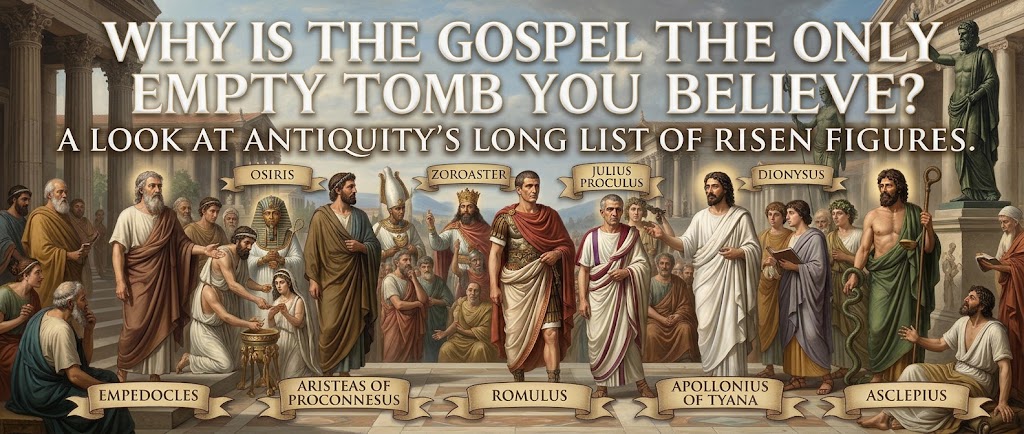
In the Greco-Roman, Egyptian, and ancient Near Eastern worlds, extraordinary individuals and divine figures were frequently believed to have defeated death, vanished from their graves, or returned to life:
- Romulus (8th Century BCE): Roman historians like Livy recorded that the legendary founder of Rome vanished during a sudden tempest and solar eclipse, leaving no body behind. Shortly after, according to the tradition, Romulus appeared in a glorified form on a public road to a Roman senator named Julius Proculus, who reported the apparition and helped establish the cult of the deified king. Proculus is the witness in the story, not a risen figure himself. (Also in Plutarch, Life of Romulus 27–28.)
- Aristeas of Proconnesus (7th Century BCE): Herodotus—the “Father of History”—recorded that Aristeas dropped dead in a shop, but his body vanished before his family could inspect it. Witnesses claimed to have met him alive on a road outside the city at the exact same hour, and he reportedly reappeared years later to write poetry.
- Empedocles (c. 494 – c. 434 BCE): Classical biographies credit the Sicilian philosopher with restoring a woman named Pantheia to life after she had been dead and without a pulse for 30 days, before Empedocles himself reportedly vanished in a flash of divine light.
- Zoroaster (Ancient Persia): Later legendary and secondary traditions sometimes attach miraculous death, ascent, or afterlife-vision motifs to Zoroaster. Those claims are late and poorly sourced compared with Livy, Herodotus, or Philostratus, so treat them as folklore about a founder-prophet rather than a documented empty-tomb parallel.
- Osiris (Ancient Egypt): Murdered and dismembered by Set, then reassembled by Isis. In Egyptian religion Osiris becomes ruler of the underworld and guarantor of afterlife for the justified dead; he does not return to ordinary earthly life the way Gospel resurrection narratives claim for Jesus. Whether Osiris belongs in a “dying-and-rising gods” category is contested in modern scholarship.
- Dionysus (Greek Mythology/Religion): The dismemberment-and-rebirth story most often compared here is the Orphic Zagreus tradition (torn by the Titans, then restored), which is mythic/cultic rather than a historical biography.
- Apollonius of Tyana (1st Century CE): A 1st-century Neo-Pythagorean philosopher and contemporary of Jesus. His biographer, Philostratus, documented his miracles, teachings, and post-death physical appearance to a doubting student to prove the immortality of the soul.
If late written accounts, empty graves, and claims of post-mortem sightings are sufficient historical proof for one case, logic dictates they must be evaluated equally across the board.
Key Sources & Simplified Reading List
For those looking to dive deeper into how these ancient resurrection and ascension stories were recorded, documented, and compared, these accessible books break down the primary sources and historical context:
- The Histories by Herodotus (Oxford World’s Classics)
What It Covers: Book 4 contains the earliest recorded history of Aristeas of Proconnesus’s sudden death, vanishing body, and subsequent reappearance, demonstrating how resurrection claims were documented by early historians. - The Early History of Rome (Books I–V) by Livy (Penguin Classics)
What It Covers: Livy’s history details the death, missing body, and resurrection appearance of Romulus to Julius Proculus, illustrating how public apparitions were used in Roman political and religious tradition. - The Life of Apollonius of Tyana by Philostratus (Translated by C.P. Jones / Loeb Classical Library)
What It Covers: The primary ancient biography of Apollonius. Reading it alongside the New Testament Gospels highlights identical 1st-century narrative structures, healing accounts, and post-death appearances. - The Egyptian Book of the Dead (Translated by Raymond Faulkner / Chronicle Books)
What It Covers: Primary texts detailing the mythology of Osiris, his resurrection, and the ancient Egyptian theology of overcoming death. - Did Jesus Exist? The Historical Argument for Jesus of Nazareth by Bart D. Ehrman (HarperOne)
What It Covers: Ehrman argues that a historical Jesus existed and critiques mythicist claims that Jesus was invented from pagan dying-and-rising gods. Useful for method and for why many historians reject simple pagan-parallel arguments, not as a brief that those parallels prove Gospel emptiness claims.