
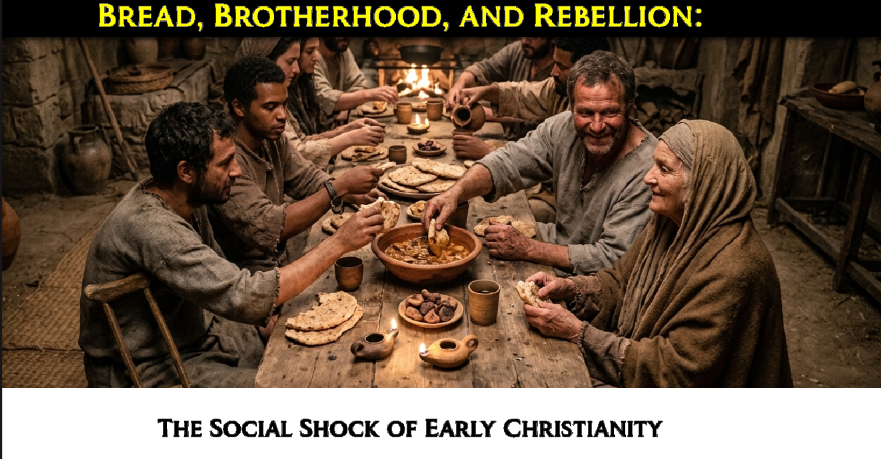
Before Christianity became the religion of emperors, councils, cathedrals, kings, and state power, it looked much more like a suspicious underground society of the poor, the displaced, the enslaved, the widowed, and the socially disposable.
That does not mean early Christianity was “bohemian” in the modern sense. It was not a modern leftist movement, a socialist party, or an organized political revolution. But from a historical and sociological perspective, early Christianity did create something socially shocking inside the Roman world: a rival community built around shared meals, fictive kinship, care for the poor, suspicion toward wealth, and allegiance to a crucified Lord rather than to Caesar’s sacred order.
That was enough to make it dangerous.
The First Christian Shock Was the Table
One of the oldest Christian texts outside the New Testament, the Didache, probably from the late first or early second century, preserves a prayer over the Eucharistic bread:
“As this broken bread was once scattered on the mountains, and after it had been brought together became one, so may thy Church be gathered together from the ends of the earth unto thy kingdom.”
The image is simple but explosive. Many grains become one loaf. Many scattered people become one body. The shared bread becomes a symbol of a gathered people, a new society, a community formed across normal divisions of status, ethnicity, kinship, and class.
This was not just “church snack time.” In an ancient world ordered by hierarchy, patronage, slavery, honor, shame, citizenship, and family rank, a ritual meal that imagined slaves, widows, artisans, foreigners, and wealthier patrons as one body carried real social meaning.
The Didache also gives a blunt ethic of material sharing:
“Do not turn away from anyone who is in need, but share everything with your brother, and do not say that anything is your own.”
That sentence is one of the clearest early Christian witnesses to the movement’s anti-possessive moral imagination. It does not necessarily prove that every Christian group practiced total communal ownership. But it does show that Christian teaching placed private property under the moral claim of human need.
That is the first shock: the bread was theological, but it was also social.
Acts Remembers the Jesus Movement as Economically Disruptive
The Book of Acts presents the earliest Jerusalem community in strikingly communal terms:
“They were selling their possessions and belongings and distributing the proceeds to all, as any had need.”
Again, historians debate how literally and how universally this was practiced. Acts is a theological narrative, not a modern census report. But the ideal is unmistakable: Christian fellowship was remembered as a community where property was made answerable to need.
That matters because Rome was not an egalitarian society. Wealth was not merely money; it was status, power, reputation, and patronage. The wealthy gave gifts downward and received loyalty upward. Charity often reinforced hierarchy.
Christian sharing could work differently. At least in its ideal form, the poor were not merely clients receiving favors from benefactors. They were brothers and sisters inside the same body.
That language was socially volatile.
A hungry person could look at a wealthy believer and say: if we are one body, why am I starving?
Brotherhood Was Not Sentimental. It Was Dangerous.
Modern readers hear “brother” and “sister” as warm religious language. In the Roman world, fictive kinship could be socially destabilizing.
Christian communities called unrelated people family. They gathered across household lines. They met in homes. They cared for widows and orphans. They ate together. They treated baptism as a new identity. They imagined a people gathered “from the ends of the earth” into God’s kingdom.
The anonymous Letter to Diognetus, usually dated to the second century, captures how Christians were seen as both ordinary and strange. They married, had children, lived in cities, and obeyed laws, yet they were also described as having a “common table” while rejecting sexual immorality. In other words, outsiders had to be told: no, their shared meals are not orgies; no, their brother-sister language is not incest.
That tells us something important. Early Christian social life was close enough, private enough, and countercultural enough that outsiders misunderstood it.
The scandal was not only doctrine.
The scandal was intimacy across normal social boundaries.
Rome Did Not Fear Christians Because They Had Armies
Christians were not militarily powerful in the first centuries. They were not marching on Rome with weapons. They were not running a political party.
Rome’s anxiety came from another place: Christians refused to treat Roman sacred order as ultimate.
Roman religion was public glue. Sacrifice to the gods and honor to the emperor were not just private beliefs. They were civic acts. They signaled loyalty, gratitude, and participation in the empire’s moral universe.
That is why Pliny the Younger, governor of Bithynia-Pontus, wrote to Emperor Trajan around 112 CE asking how to deal with Christians. Pliny’s issue was not that Christians were thieves or murderers. His concern was their stubborn refusal to conform. He tested accused Christians by requiring them to invoke the gods, offer wine and incense before the emperor’s image, and curse Christ. Those who refused were punished.
This is crucial: Christians were dangerous not because they were violent, but because they were unassimilable.
They would not simply add Jesus to the Roman pantheon.
They would not say Caesar’s sacred honor was harmless.
They would not let empire define the highest loyalty.
Nero Shows How Easy It Was to Scapegoat Them
The classic example is Nero after the Great Fire of Rome in 64 CE. Tacitus says Nero shifted blame onto Christians, a hated minority, after suspicion fell on him. Tacitus does not portray Christians sympathetically; he says they were hated and associated with “hatred of the human race.” But the passage shows precisely why Christians made useful scapegoats: they were visible enough to accuse, strange enough to despise, and powerless enough to punish.
That accusation, “hatred of the human race,” probably reflects the way Roman elites could interpret Christian separation from public cults, festivals, sacrifices, and civic religious life. If you refused the gods who protected the city, you could be blamed when disaster came.
So Christians were not scapegoated because everyone carefully studied their theology. They were scapegoated because they were socially suspicious.
They did not worship correctly.
They met privately.
They called each other family.
They rejected the gods.
They honored a crucified man.
They imagined another kingdom.
That was enough.
Care for the Poor Helped Christianity Spread
One major scholarly explanation for Christianity’s growth is that Christian communities provided unusually strong mutual aid. Sociologist Rodney Stark famously argued in The Rise of Christianity that the movement grew partly because it created dense networks of care, especially in cities marked by disease, poverty, instability, and abandonment.
This argument is debated, but it remains influential: Christian charity, nursing during epidemics, support for widows, burial of the dead, and care for strangers may have made Christian communities socially attractive in a brutal urban world. Later Christian and pagan sources both suggest that Christian care for the poor became a public marker of the movement.
A striking later example comes from Emperor Julian, the fourth-century ruler who tried to revive traditional pagan religion after Constantine’s dynasty had favored Christianity. Julian complained that the “Galileans,” meaning Christians, supported not only their own poor but pagan poor as well. His complaint is important because it comes from an opponent of Christianity, not a Christian propagandist.
That does not prove that every Christian community was morally pure. It does show that charity had become one of Christianity’s public weapons.
The poor were not a side issue.
They were part of the movement’s credibility.
The Counter-Imperial Reading
A number of modern scholars argue that early Christian language carried an implicit or explicit challenge to Roman imperial ideology.
N. T. Wright, for example, has argued that Paul’s gospel must be read in a world where Caesar claimed divine favor and universal lordship. In that context, proclaiming Jesus as Lord was not merely a private spiritual claim. It placed Jesus’ kingdom and Caesar’s empire in symbolic conflict.
This does not mean every Christian sentence was a coded anti-Roman manifesto. That would be too simple. But the language of kingdom, lordship, peace, salvation, gospel, and allegiance overlapped with imperial vocabulary. Rome had its own “good news.” Rome had its own lord. Rome claimed to bring peace.
Christianity announced a different Lord, a different peace, and a different kingdom.
That is why the movement could be socially rebellious without being conventionally revolutionary.
It did not need swords to threaten Rome’s imagination.
The Wealth Question Was Always There
Early Christianity did not teach a single, simple economic program. Wealthy patrons existed in Christian circles. House churches often depended on people with homes large enough to host gatherings. Paul collected money from Gentile churches for poor believers in Jerusalem. Later bishops administered funds for widows, orphans, prisoners, and strangers.
So the point is not “all early Christians were poor” or “Christianity was purely anti-rich.” That would be historically false.
The sharper point is this: early Christianity placed wealth under judgment.
Wealth was not treated as neutral self-expression. It was dangerous, morally accountable, and obligated to the needy. The Didache says not to claim things as simply your own when your brother is in need. Acts remembers believers selling possessions so no one lacked. Later Christian writers continue this suspicion of hoarded wealth.
That is shocking to modern Christians who have inherited a comfortable, property-protecting, empire-friendly version of the faith.
The earliest Christian question was not, “How much can I keep and still be blessed?”
It was closer to, “How can I call this person brother while refusing him bread?”
Rome Eventually Adopted What It Could Not Erase
Here is the historical irony:
The movement centered on a crucified man eventually became favored by emperors.
The religion of the socially suspicious became a religion of imperial legitimacy.
The table of the poor eventually stood inside basilicas funded by power.
That transformation was not instant, and it was not simple. Constantine did not single-handedly “invent” Christianity or erase its earlier forms. But imperial adoption changed the social location of the faith. Christianity moved from the margins toward the machinery of law, patronage, doctrine, and statecraft.
The empire that once punished Christians eventually learned to use Christianity.
That is one reason the early material can feel so startling. The Didache’s shared bread, Acts’ common possessions, Pliny’s stubborn Christians, Nero’s scapegoats, Julian’s complaint about charity — all of it points back to a movement that was once socially disruptive before it became socially dominant.
Final Thought
So was early Christianity a “bohemian movement to help the poor and take down Rome”?
Not exactly.
That phrase is too modern and too blunt.
But was early Christianity a countercultural movement whose shared meals, fictive brotherhood, care for the poor, critique of wealth, and refusal of imperial religious loyalty made it socially shocking?
Yes.
That is a defensible scholarly position.
The earliest Christians did not need to storm the Senate to challenge Rome. They challenged Rome every time they gathered around a table and said:
The poor belong here.
The slave is our brother.
The widow is not forgotten.
The hungry must be fed.
The scattered must become one.
And Caesar is not Lord.
That was the rebellion.
Not a rebellion of swords.
A rebellion of bread.