Open Revelation and look for the word Antichrist. You can read all twenty-two chapters and come up empty. Open First John and you’ll find something stranger. The writer says “many antichrists have come” (1 John 2:18). Then he says they went out from his own community.
The word people now use for a future world ruler appears in the Bible as a label for people who had already walked out the door. So how did those defectors wind up sharing a résumé with a Roman emperor, a beast from the sea, and a man who sits in God’s temple?
Before the Antichrist, there was a king who died in the wrong place
In the 160s BCE, the Seleucid king Antiochus IV Epiphanes intervened in Judea and disrupted worship at the Jerusalem temple. The dominant scholarly reading identifies him with the boastful little horn of Daniel 7 and the king at the center of Daniel 11:21–45.
Daniel 11 gets remarkably specific about power struggles and wars before its account breaks with known history. In verses 40–45 the king pitches his tents near the holy mountain and comes to his end. Antiochus died campaigning in the east, in what is now Iran. Many historians read that change in accuracy as a clue to when the vision took shape. Its author could describe what had already happened in detail. The final confrontation was still ahead of him.
Fragments of the closing vision survive in the Dead Sea Scrolls manuscript 4Q114. The documentary hypothesis concerns the composition of the Pentateuch, the first five books of the Bible. Daniel’s date and literary development are a separate question.
Jesus’ warning gets edited in plain sight
In Mark 13:14, Jesus warns of a desolating sacrilege standing where it should never stand. The narrator interrupts to tell the reader to understand. Matthew 24:15 makes the reference explicit by naming Daniel and putting the sacrilege in the holy place. Luke 21:20 gives readers something they can picture without solving a riddle. Jerusalem is surrounded by armies.
Most specialists in the Synoptic Problem, the question of how Matthew, Mark, and Luke are related, hold that Mark came first and that Matthew and Luke used it. They still debate how the later two relate to each other. On Markan priority, these passages let you watch two authors reshape a shared warning. That’s redaction criticism with the evidence on the page. Mark and Matthew also warn about false messiahs and false prophets in the plural (Mark 13:22 and Matthew 24:24).
One letter has the name. Another has the villain.
First John knows an expectation that antichrist is coming, then applies the label to opponents who already exist. In 2:19 they have separated from the community. In 2:22 the issue is denial that Jesus is the Christ. Second John 7 calls people deceivers and antichrist in connection with their refusal to confess Jesus Christ coming in the flesh. You can hear one side of a fight over what Christians had to believe about Jesus. The people who left never get a reply in the letter.
Second Thessalonians 2 has a different figure. The man of lawlessness exalts himself, takes a seat in God’s temple, and is destroyed when Jesus appears. The letter bears Paul’s name, and scholars dispute whether Paul wrote it. His undisputed First Thessalonians likewise expects Jesus to return, but its famous scene of believers meeting the Lord in the air (4:13–18) gives the lawless one no role. The fourth-century Codex Sinaiticus preserves both 1 John 2 and 2 Thessalonians 2. You can look at their separate wording in the same ancient Bible.
What if the number of the Beast is 616?
Revelation 13 gives its sea beast traits drawn from Daniel’s beasts, then dares readers to calculate its number. The usual reading is 666, found in the early manuscript Papyrus 47. Papyrus 115, another early copy, reads 616. Irenaeus already knew of the lower reading around 180 CE and defended 666, so the disagreement predates the surviving papyrus. Comparing witnesses like these to learn how the text was transmitted is textual criticism.
One leading explanation makes sense of both numbers. Write the Greek form Neron Caesar in Hebrew letters and add their numerical values. The result is 666. Use the shorter Nero Caesar, dropping the final n worth 50, and you get 616. Scholars still debate the solution, but the fit explains why a first-century reader might have thought of Rome and its emperor. Revelation supplies a riddle its audience is invited to solve. A modern barcode is a very late entry in that contest.
A bishop puts the pieces together
Around 180 CE, Irenaeus of Lyons read Daniel’s blaspheming ruler and Second Thessalonians’ lawless one as the same future enemy. He also treated Revelation’s Beast and its number as part of the Antichrist’s story. In Against Heresies, you can catch an early Christian interpreter doing the very work that later readers take for granted.
Canonical criticism asks what happens when these texts are read together as Scripture. Historical criticism asks what each text was doing in its own setting. You can read them together as a prophecy. The historical record also lets you watch readers assemble that prophecy from writings that give the enemy different roles.
This is where a mythicist lens asks a useful question. How much of a character can communities build by rereading Scripture and attaching old images to new enemies? Richard Carrier has made a minority case that Jesus began as a mythical figure. The prevailing scholarly view holds that Jesus was a historical person, and published debate over mythicism falls well short of broad acceptance. The Antichrist offers a case where the surviving writings show the construction of a figure even though some of its raw material came from real rulers.
Read First John again after all that. The author thinks the last hour is already here, and his evidence is that people have left his community. If someone tells you the Bible gives one unmistakable profile of a future Antichrist, hand them that verse. Then ask them to show you where Revelation calls the Beast by that name.
Sources
- National Council of Churches, New Revised Standard Version Updated Edition, 2021. Biblical text
- John J. Collins, Daniel: A Commentary on the Book of Daniel, 1993. Bibliographic record
- Anonymous scribe, 4Q114 (4QDanielᶜ), Second Temple period. Israel Antiquities Authority manuscript archive
- Mark Goodacre, The Synoptic Problem: A Way Through the Maze, 2001. Author’s site
- Paul Foster, “Who Wrote 2 Thessalonians? A Fresh Look at an Old Problem,” 2012. Journal article
- Anonymous scribes, Codex Sinaiticus, fourth century CE. Manuscript and transcription
- Anonymous scribes, Papyrus 47 (Chester Beatty Biblical Papyrus III), third century CE, and Papyrus 115 (P.Oxy. 4499), third or fourth century CE. Chester Beatty catalogues and Papyrus 115 manuscript record
- David C. Parker, “A New Oxyrhynchus Papyrus of Revelation: P115 (P. Oxy. 4499),” 2000. Journal article
- Craig R. Koester, “The Number of the Beast in Revelation 13 in Light of Papyri, Graffiti, and Inscriptions,” 2016. Journal article
- Irenaeus of Lyons, Against Heresies, Book V, chapters 25–30, c. 180 CE. English translation
- Bernard McGinn, Antichrist: Two Thousand Years of the Human Fascination with Evil, 1994. Bibliographic record
- Philip C. Almond, The Antichrist: A New Biography, 2020. Cambridge University Press
- Richard Carrier, On the Historicity of Jesus: Why We Might Have Reason for Doubt, 2014. Bibliographic record
- Bart D. Ehrman, Did Jesus Exist? The Historical Argument for Jesus of Nazareth, 2012. Author’s publication announcement
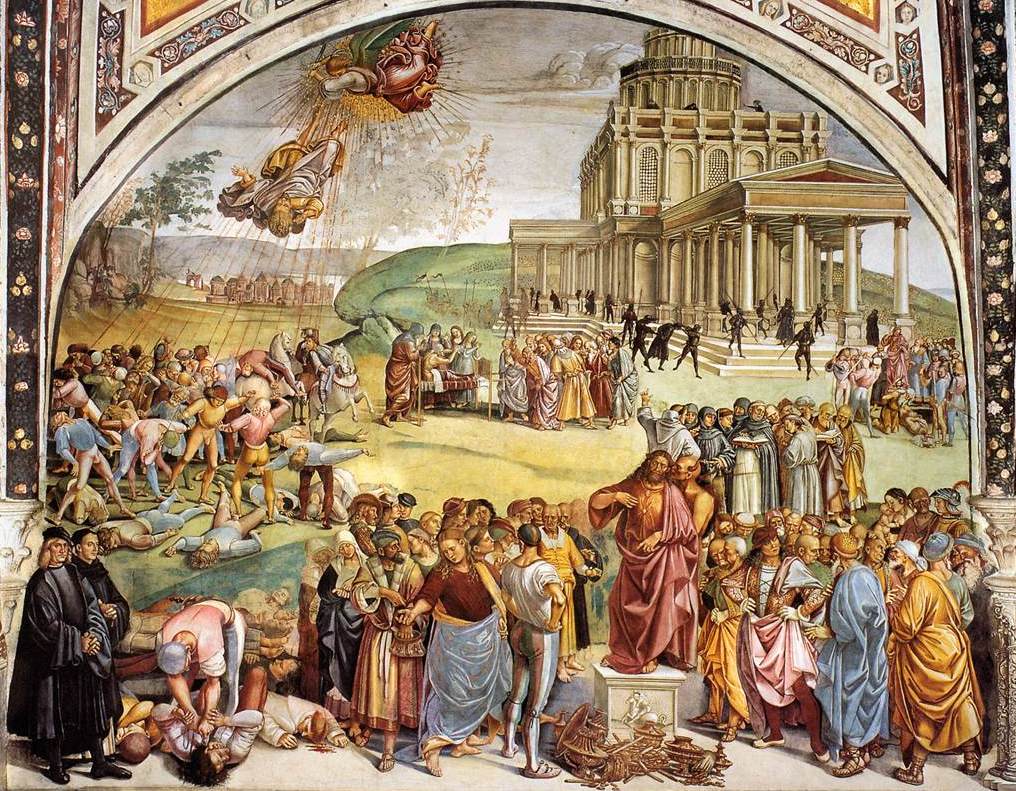
- Luca Signorelli, Sermon and Deeds of the Antichrist, c. 1499–1502. Public-domain fresco image

Research guide: Markan Priority and the Synoptic Problem; Jesus Historicity and Mythicism; Ancient Manuscripts and Textual Variants; Origins of Satan, Hell, and the Antichrist
Related reading
- Did 666 from Revelation Mean Nero?
- Hell as We Know It Today Is Not from the Bible
- Was Satan Introduced Later Under Persian and Hellenistic Influence?
- What the Synoptic Problem Reveals About How the Gospels Were Written
- A look at other resurrection stories from antiquity
- Is the Rapture a 19th-Century Hoax?