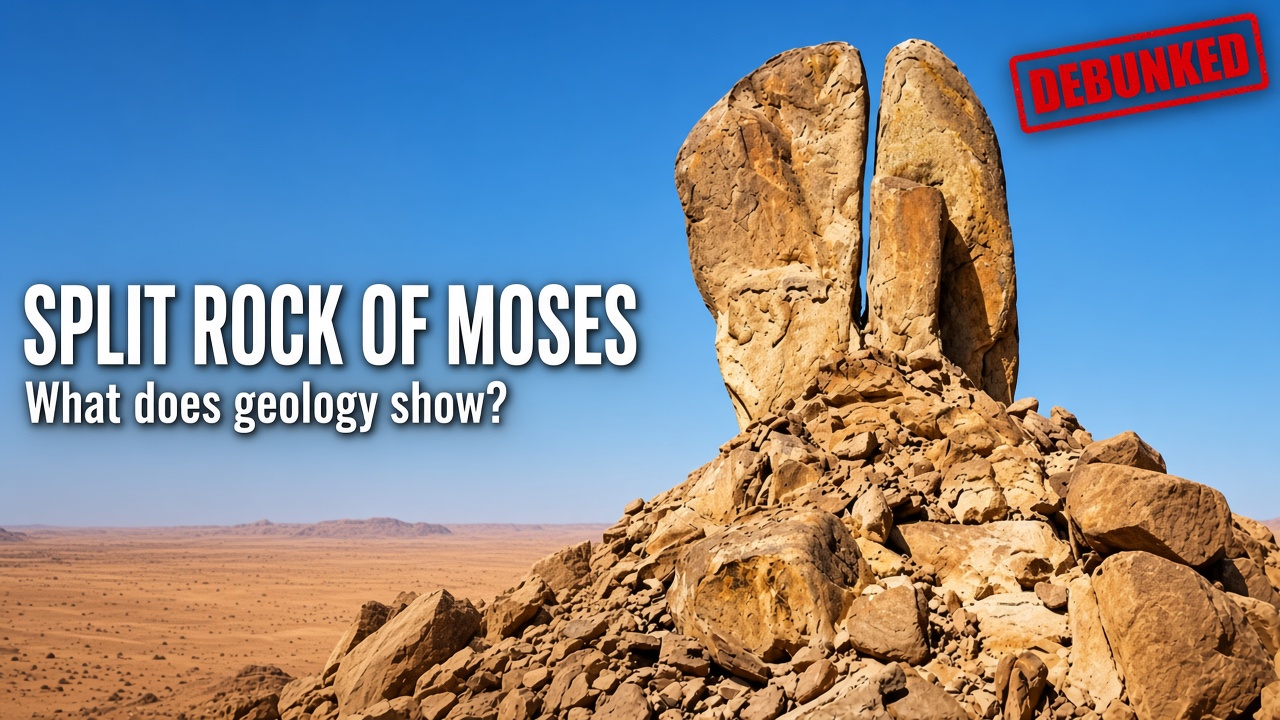
A huge split boulder near Jabal al-Lawz in northwestern Saudi Arabia is often presented as physical evidence for Exodus 17, where Moses strikes a rock and water comes out.
It is a striking sight. But a dramatic shape is not the same thing as evidence. As far as the published record goes, what we can see at the site looks like the kind of rock that geologists describe in deserts around the world.
Short version: the rock is a real and impressive landmark. Its link to Moses is an interpretation, not a finding.
What We Can Observe vs. What Is Being Claimed
Before getting into the geology, it helps to separate the two.
What we can observe (mostly from photos, drone video and maps):
- A very large boulder with a deep, roughly vertical split, sitting on a mound of rubble.
- Other cracked, rounded and weathered rocks around it.
- Smoothed surfaces and channels nearby, inside a network of dry streambeds (wadis).
- A region whose mountains are mapped as mostly granite, cut by volcanic dikes.
What is being claimed:
- That this is the rock Moses struck.
- That the split was caused by that event.
- That the smoothed channels were carved by miraculous water flowing from it.
- That the nearby mountain (Jabal al-Lawz or Jabal Maqla) is the biblical Mount Sinai.
The rest of this article asks a simple question: do the observations require the claims? In my view they do not.
How Rocks Like This Form: The Geology, Explained Once
Three ordinary processes do most of the work. I’ll explain them here and then point back to them.
1. Joints (the cracks). Granite and similar rocks naturally develop cracks called joints. These form as rock cools, as tectonic forces stress it, and as the weight of overlying rock is removed by erosion. The U.S. Geological Survey notes that Joshua Tree National Park “has numerous joints (cracks in rocks)”, and that the park even has a feature named Split Rock.
2. Weathering (the widening and rounding). Once a crack exists, water gets in. Over long periods, chemical weathering breaks down minerals along the crack, and corners round off. The USGS describes how this turns fractured granite into rounded boulders and knob-shaped outcrops in the Mojave Desert. In colder spells, freezing water can also wedge cracks wider.
3. Flash floods (the water marks). Deserts get little rain, but when it comes it can come hard. The National Park Service says that in arid lands, “running water during a flash flood can carry tremendous amounts of material.” Over long periods, this carves channels and polishes exposed rock.
None of this requires anything unusual. These processes happen wherever this kind of rock meets this kind of climate.
Is It Even Granite?
Probably, but it is worth being careful.
Geological mapping of the Jabal al-Lawz area describes the mountain as light-colored granite cut by volcanic dikes. Granite also makes up the lower slopes of nearby Jabal Maqla. A geology-minded blogger who studied photos and video of the split rock describes it as granite too, though he says plainly that he has never visited the site.
I’m not aware of any published lab analysis of the boulder itself. So “granite, or a similar crystalline rock” is the fair description. It doesn’t change the argument much, because cracked boulders of this kind are common in this sort of rock.
The Split Itself
Observation: the boulder has one especially prominent split, and the rocks around it are also cracked and weathered.
Interpretation: the split is consistent with the jointing and weathering described above. The famous boulder looks like a more photogenic example of what is happening to the rocks around it, not something standing apart from them.
The exact history of this particular crack is unknown. Working it out would take fieldwork. Some commentators suggest frost wedging. One has even suggested the boulder was carried there by ancient glaciers, which he admits is a guess. But not knowing the exact sequence is a normal gap in knowledge, not a gap that a miracle needs to fill.
The region also has context. Northwestern Arabia sits along the Red Sea rift, where Arabia and Africa are slowly pulling apart. That is the kind of setting where fractured bedrock is expected.
Other Fractured Boulders in the Region
Al Naslaa: another dramatically split rock in northwestern Saudi Arabia
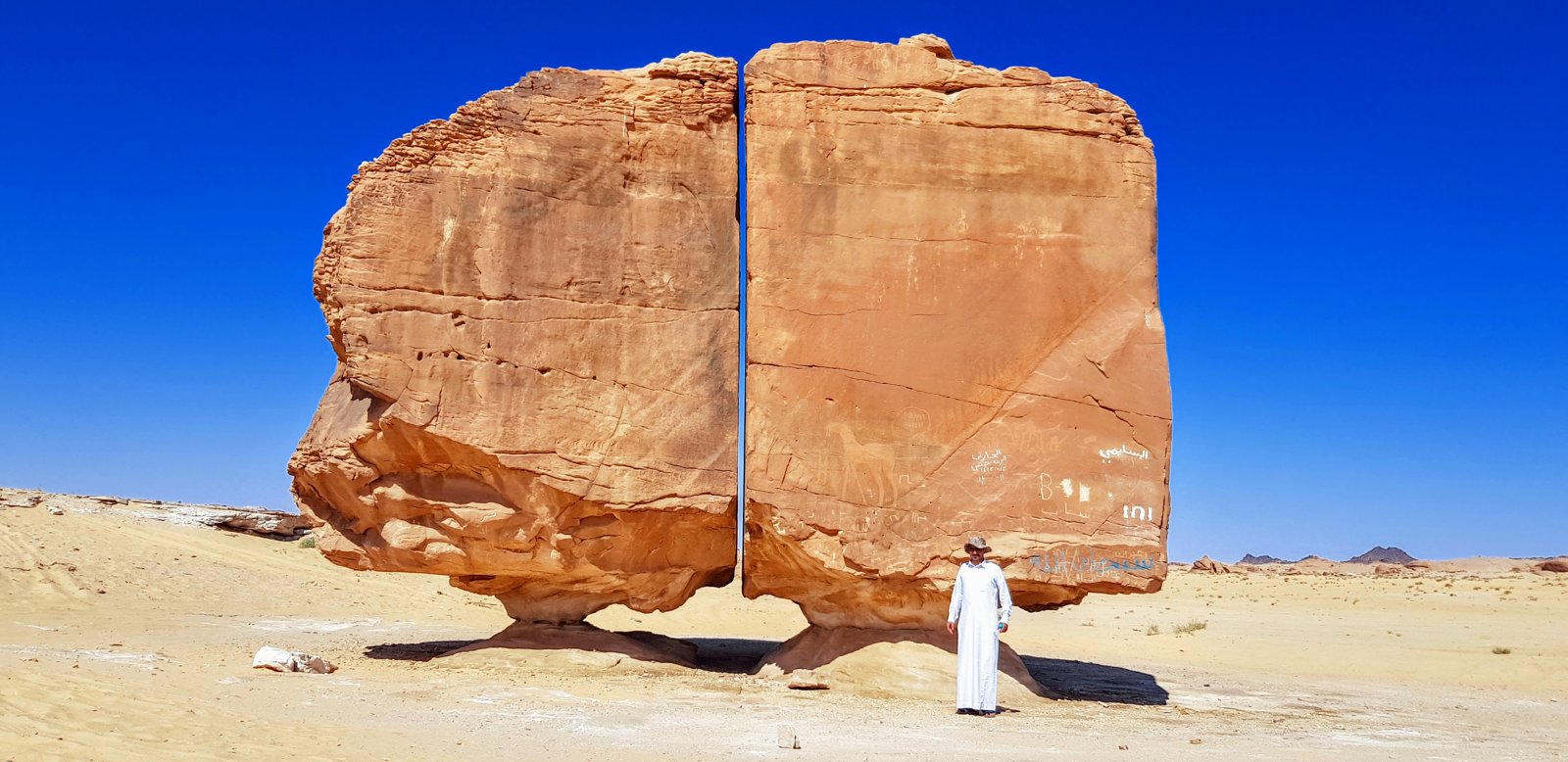

Observation: Al Naslaa, about 50 km south of the Tayma oasis, is a sandstone block roughly 6 m (20 ft) high, split into two halves by a strikingly straight vertical gap. Each half rests on a small pedestal, and one face is covered in ancient petroglyphs of horses and ibex.
It sits roughly 360 km (about 225 miles) in a straight line from Jabal al-Lawz. It is also a different rock: sandstone, not the granite mapped around Jabal al-Lawz.
Interpretation: the exact cause of the split is uncertain. Proposed explanations include natural jointing, tectonic fracturing, freeze-thaw weathering and later erosion by wind and water. These are the same kinds of processes described in How Rocks Like This Form above: a crack forms first, and weathering and erosion then widen it.
Why it matters here: the supposed Moses rock is not the only dramatic split formation in the region. Al Naslaa is arguably even more spectacular, and nobody claims it needs a biblical story to explain it.
Closer to Jabal al-Lawz, photos of the site also show many other cracked, flaking and rounded boulders around the famous one, as the geology analysis cited below points out. I’m not aware of any formal survey that catalogues them, but the famous boulder does not appear to be alone.
An unusual-looking crack is not, by itself, evidence of an unusual cause.
The Water Marks
Observation: visitors report smoothed rock and channels running down from the boulder, and smoothed ground in the surrounding wadi.
Claim: these were carved by large volumes of water pouring from the rock. Some promoters say the area gets too little rain to explain them otherwise.
Interpretation: this is the flash-flood process from above. Even Gordon Franz, a writer who accepts the biblical account, notes that the region gets up to about 4 inches (100 mm) of rain a year, and that earlier travelers in Midian reported heavy rains and floods. Satellite images show the rock sits in a drainage basin fed by higher ground to the east and south. So runoff from upslope is a straightforward source for the erosion.
There is also a logic problem. Evidence that water once flowed past a rock does not tell you that the water came out of the rock. As far as I know, nobody has shown an erosion feature there that ordinary runoff over long periods could not produce.
What the Bible Actually Says
Exodus 17:6reads, in the NRSV: “Strike the rock, and water will come out of it.” God says he will stand “on the rock at Horeb.”
That’s it. The verse does not describe:
- a freestanding boulder,
- a vertical split,
- or two halves with a gap between them.
It doesn’t say the rock split at all.
Later poetry does use the language of splitting. Psalm 78:15 says God “split rocks open in the wilderness,” and Isaiah 48:21says “he split open the rock, and the water gushed out.” These are hymns looking back on the wilderness story. They are not site descriptions, and they give no location, size or shape.
So the details that make this boulder seem like a match were supplied by modern interpreters, not by the text.
The reasoning tends to run in a circle: find a split rock, decide it looks like the story, then use the resemblance as proof that the story happened there. That is pattern-matching, not archaeology.
The Archaeology
Observation: I’m not aware of any securely dated inscription, excavation or independently verified find that ties this boulder to Moses, to an Israelite camp, or to a sudden release of water.
Claim: the boulder is near the “real” Mount Sinai, so it must be the rock of Horeb.
Interpretation: that depends on another disputed claim, that Jabal al-Lawz or Jabal Maqla is Mount Sinai. Scholars and writers have proposed many different sites for Sinai. The Saudi identification was popularized by Ron Wyatt and Bob Cornuke and has been criticized even by authors who accept the Exodus as history. Gordon Franz, for example, argues that the biblical text places Sinai outside Midian altogether.
And even if a large ancient group had camped nearby, that would not show that water came miraculously from this particular rock.
Putting a biblical name on a rock does not turn it into archaeological evidence.
Why the Miracle Explanation Doesn’t Add Anything
There is a difference between “we don’t know exactly how this happened” and “something supernatural happened.”
Here, even the mystery seems overstated. Every feature people point to (the split, the rounding, the cracked rocks around it, the water-smoothed channels) has an ordinary explanation already covered above: jointing, weathering and flash floods.
The miracle explanation, by contrast:
- offers no mechanism that can be tested,
- offers no independent dating,
- and predicts nothing we could check.
It doesn’t explain the rock better. It just adds a story to it.
Conclusion: A Natural Landmark With a Borrowed Story
The so-called Split Rock of Moses (some call it the Rock at Horeb) is a genuinely striking landmark. But its religious identification rests on visual resemblance and on assuming the biblical location in advance.
Its split, its rounded surfaces and the water marks nearby all fit well-understood processes. Similar split rocks exist elsewhere, including in the same country. And the Bible never describes the rock in a way that would single out this boulder.
I know of no published scientific or archaeological evidence connecting this rock to Moses, let alone showing that water burst from it by supernatural means. If such evidence appears, it should be judged on its merits. Until then, the natural explanation is by far the better one.
The remarkable thing about the Split Rock of Moses is not that geology can’t explain it. It’s how a natural rock formation has been repackaged as evidence of a miracle.
Sources
- U.S. Geological Survey — Granitic Rocks and Associated Landforms (Mojave): how fractured granite weathers into rounded boulders and knobs in arid regions.
- U.S. Geological Survey — Geology of Joshua Tree National Park: joints, spheroidal weathering, frost wedging, and the park’s own “Split Rock”.
- National Park Service — Arid and Semi-arid Region Landforms: flash floods as a major agent of erosion in deserts.
- The Back of My Mind — Geology and the Saudi Sinai: a geology-minded blogger’s photo-based analysis of the split rock, its rock type, weathering and local drainage. The author notes he has not visited the site.
- Gordon Franz, Associates for Biblical Research — Is Mount Sinai in Saudi Arabia?: history of the Jabal al-Lawz claims, local rainfall and floods, and a biblical-geography case against the identification.
- Wikipedia — Jabal al-Lawz: summary of the 1967 geologic map of the Jabal al Lawz quadrangle (granite with rhyolite and andesite dikes; granite on Jabal Maqla’s lower slopes).
- Wikipedia — Al Naslaa rock formation: the split sandstone block near Tayma and the proposed natural explanations.
- Bible Gateway — Exodus 17:6; Psalm 78:15–16; Isaiah 48:21 (NRSVUE): the verses quoted above.