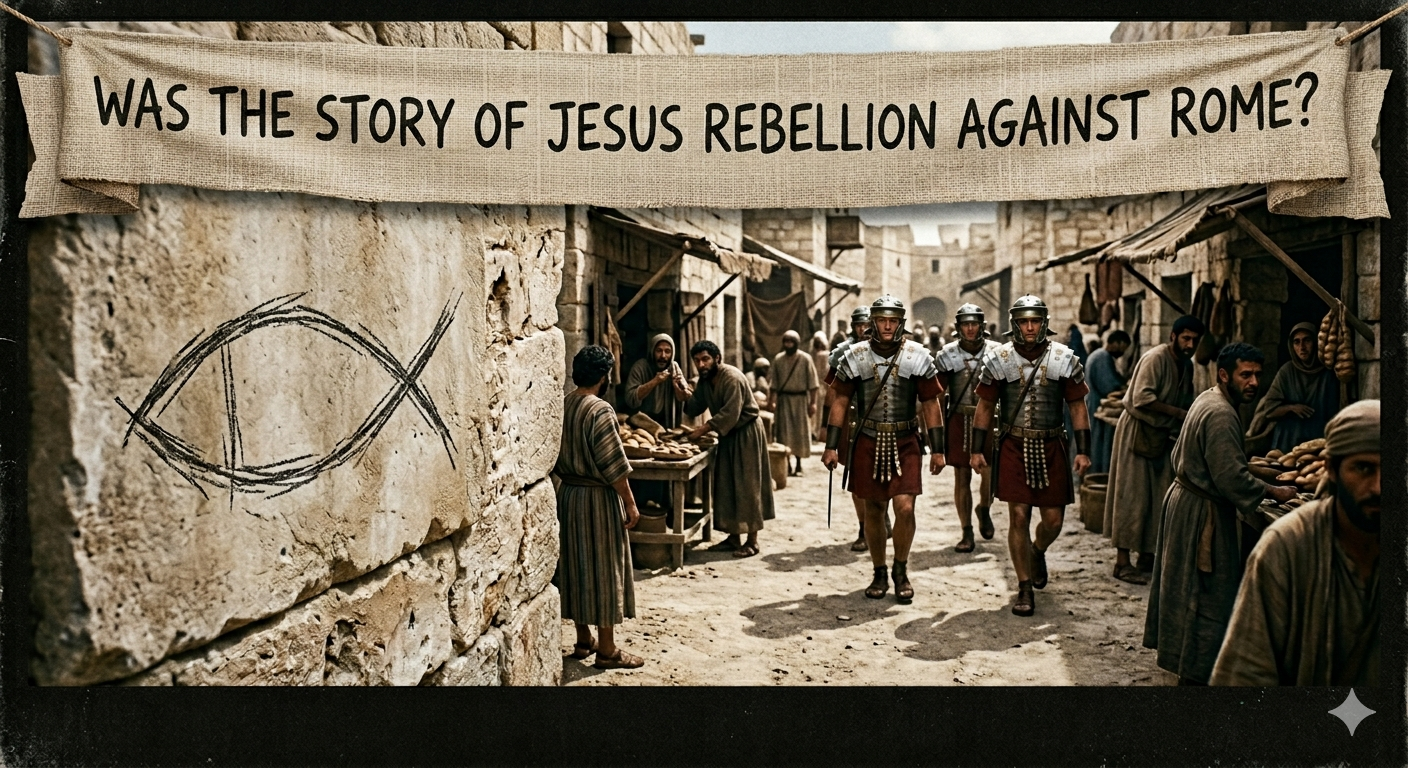
The question isn’t whether the message of Jesus Christ was political—it’s how political it was understood to be in a world dominated by Rome. For people living under imperial occupation, words like “kingdom,” “lord,” and “son of God” were not abstract theology. They were the language of power.
A World Already Shaped by Revolt
Long before the Jesus movement spread, Judea had a deep memory of resistance. The Maccabean Revolt established a powerful precedent: foreign rule could be resisted, overthrown, and replaced with a restored, purified temple order. That memory didn’t disappear—it shaped expectations for generations.
By the 1st century, Roman occupation intensified those tensions. Taxation, military presence, and collaboration between local elites and imperial authorities created a volatile environment. That pressure eventually erupted in the First Jewish–Roman War, culminating in the destruction of Jerusalem and the Temple in 70 CE.
The Temple—descended from earlier sacred structures like the Tabernacle—was not just a religious site. It was the symbolic center of identity, law, and divine presence. Its destruction was not just political defeat—it was existential collapse.
Into that environment, any message about a coming “kingdom” could not help but carry weight.
Kingdom Language in an Imperial World
In the Roman world, Caesar was hailed as “lord” (kyrios) and “son of god” (divi filius). These were not metaphorical—they were political claims tied to authority and loyalty.
So when early followers proclaimed Jesus using the same language, the overlap was unavoidable:
- “Lord”
- “Son of God”
- “Kingdom of God”
Scholars like N. T. Wright and John Dominic Crossan argue that this language functioned as a competing vision of rule—not necessarily violent revolt, but a redefinition of allegiance. The claim wasn’t simply spiritual. It was that true authority belonged elsewhere.
The Beast, the Number, and Concealed Resistance
This tension becomes explicit in texts like the Book of Revelation, where Rome is symbolized as a beast. The infamous number 666—and in some manuscripts 616—is widely understood by scholars to encode the name of Nero through Hebrew numerology (gematria).
This wasn’t random symbolism. Jewish tradition already used coded language to describe oppressive empires—beasts in the book of Daniel, for example, represented successive imperial powers. It was a way to speak about domination and resistance without stating it directly.
“Let the one who has understanding calculate the number…” (Revelation 13:18)
That line assumes something:
the audience already knows this is about Rome.
The number wasn’t a mystery for them—it was protection. A way to name the oppressor without inviting immediate consequences.
Christians as Scapegoats in Roman Society
As the movement spread, it did not go unnoticed. Roman authorities were less concerned with theology and more with stability. Groups that refused to participate in emperor worship or civic religion could be seen as socially disruptive.
By the time of Nero, Christians were already visible enough to be blamed. After the Great Fire of Rome in 64 CE, they were scapegoated and persecuted—portrayed as outsiders whose beliefs threatened order.
Roman writers like Tacitus describe Christians as a distinct and suspicious group. What mattered wasn’t doctrine—it was refusal to conform.
In a system built on public loyalty, that refusal could be read as defiance.
Message, Movement, and Meaning
What made the Jesus movement powerful was not just its stories—but how those stories functioned. They were repeated in gatherings, shared across cities, and lived out in communities that saw themselves as belonging to something larger than Rome.
This is where the contrast with Apollonius of Tyana becomes revealing. His life, preserved later by Philostratus, includes miracles, teachings, and followers—but it exists as a contained narrative. It does not emerge from or sustain a widespread network of communities redefining identity under imperial pressure.
The Jesus story did.
From Tension to Adoption
By the time Constantine the Great embraced Christianity in the 4th century, the movement had already spread widely. This was not the creation of a new religion—but the stabilization of one that had proven resilient.
A message that once carried the language of alternative rule could now be structured, organized, and aligned with imperial authority. Councils defined belief. Texts were standardized. What had been a decentralized movement became a unified tradition.
Rome did not simply suppress the message—it absorbed it.
Sources:
Richard A. Horsley, Jesus and Empire: The Kingdom of God and the New World Disorder, 2003.
“Jesus’ movement opposed Roman imperial order through kingdom proclamation, exorcism, and village renewal.”
John Dominic Crossan, God and Empire: Jesus Against Rome, Then and Now, 2007.
“Jesus preached God’s kingdom over against Rome’s empire of violence and force.”
Warren Carter, The Roman Empire and the New Testament, 2006.
“Carter brings the Roman Empire to the foreground as a major political setting for New Testament interpretation.”
Neil Elliott, The Arrogance of Nations: Reading Romans in the Shadow of Empire, 2008.
“Romans is read “in the shadow of empire,” exploring justice, obedience, mercy, and power.”
N. T. Wright, Jesus and the Victory of God, 1996.
“The gospel is about the kingdom of God clashing with the kingdom of Caesar.
Paula Fredriksen, Jesus of Nazareth, King of the Jews, 1999.
“Rome crucified Jesus under a political charge, using execution as public crowd control.”
Martin Goodman, Rome and Jerusalem: The Clash of Ancient Civilizations, 2007.
Goodman explains the Roman-Jewish struggle that led to Jerusalem’s destruction and shaped later Christian identity.
Bart D. Ehrman, Jesus: Apocalyptic Prophet of the New Millennium, 1999.
Jesus preached an apocalyptic kingdom indirectly relativized Roman power.