
Christian nationalism is not the Christian message. Ted Cruz is wrong about Christianity, and the mistake is on tape.
In a short 2025 clip, Cruz tells Tucker Carlson that the Bible commands Christians to support Israel, that the line is in Genesis, and that the “nation” means the modern state headed by Benjamin Netanyahu. Asked how long that country has existed, he says “for thousands of years.” That is not what Genesis says, not how Paul read it, and not how history dates the state.
The auto-captions never say Genesis 12:3, Christian nationalism, or Armageddon. The speakers do something narrower, and it is enough: they take a promise spoken to Abram and pin it on a republic founded in 1948. That is not the historic Christian message. A later theology, dispensational Christian Zionism, is what turns the same promise into a clock for war.
What the clip actually says
The video is a roughly two-and-a-half-minute reupload by ClassicClipsVault (19 June 2025), titled “Tucker Carlson vs. Ted Cruz on Israel: Christian Zionism.” The last two words are the channel’s, not Cruz’s or Carlson’s. Captions are automatic.
- Cruz’s claim: Sunday school taught that those who bless Israel are blessed and those who curse Israel are cursed. He wants the blessing side. He says Christians are “commanded” to support Israel, and at one point the government of Israel. The verse, he says, is “in Genesis,” though he cannot cite the number.
- Carlson’s question: Define Israel. Is Genesis talking about a people, or about current borders and Netanyahu’s government?
- Cruz’s answer: God means “the political entity called Israel.” Asked how long that country has existed, he says “for thousands of years.” When Carlson says most people take the line as the Jewish people, Cruz replies, “That’s not what it says.”
No one says Armageddon. No one says “Christian nationalism.” The error that is spoken is already large: a Genesis promise is declared identical to a modern government, and that government is declared thousands of years old.
What Genesis 12 says
“Now the Lord had said unto Abram, Get thee out of thy country, and from thy kindred, and from thy father’s house, unto a land that I will shew thee: And I will make of thee a great nation, and I will bless thee, and make thy name great; and thou shalt be a blessing: And I will bless them that bless thee, and curse him that curseth thee: and in thee shall all families of the earth be blessed.”
Genesis 12:1–3, King James Version
That is the Sunday-school line, with the verse number Cruz could not find.
Who is “thee”? Abram. Not a parliament. Not a prime minister. Not a flag from the twentieth century.
What does the curse cover? In the King James, following the Hebrew, it curses “him that curseth thee,” a singular. The classroom slogan already widened that into “those who curse Israel.” Cruz widens it again: from a man, to a people, to a state, to a government he says Christians must support.
What is the last clause? “In thee shall all families of the earth be blessed.” That points outward, toward the nations, not inward as a loyalty test for one modern ally.
The Society for Old Testament Study treats Genesis 12:1–3 as a promise text about descendants, land, and relationship with God. David Clines calls the Pentateuch’s theme the partial fulfilment of the promise to the patriarchs. Partial matters. Nothing in the chapter is a foreign-policy order to a later empire.
The wording is ancient. The Leningrad Codex (copied 1008/9) preserves a complete Masoretic Hebrew Bible. Age of the sentence is not age of the political reading. A line can be old and still be drafted into a job it does not do.
When the book was written
Most modern scholars do not treat Genesis 12 as a transcript from Abram’s lifetime. Mosaic authorship of the Pentateuch is rejected in mainstream critical work. The books are composite: doublets, different divine names, laws that do not always agree.
What replaced the single-author story is contested. The old Documentary Hypothesis (Yahwist, Elohist, Priestly, Deuteronomy) is no longer uncontested. The Society for Old Testament Study’s common point: distinguish Priestly from non-Priestly material, and date something like the present form to the fifth century BCE or later. On any model, the promise to Abram is literature shaped as a people’s origin story, not a charter for a republic declared in Tel Aviv.
Paul already read the blessing, and he read the nations
The New Testament already comments on this verse, and not in Cruz’s direction. Paul in Galatians 3:8says scripture foresaw God justifying the Gentiles by faith, and preached the gospel beforehand to Abraham:
“In thee shall all nations be blessed.”
Paul reaches for the last clause: the blessing of the nations through faith. He is not issuing a curse against governments that fail to arm a future state. Historic Catholic, Orthodox, and Protestant reading followed that outward turn. They did not teach that a senator two thousand years later was biblically commanded to support a particular prime minister.
Carlson is closer to the grammar when he says most people take the line as the Jewish people. Even that is later identification. The sentence addresses Abram. “The Jewish people” is a defensible religious reading of the promised offspring. “The political entity called Israel,” said of a government elected in the twentieth century, is a different claim. Cruz rejects the people-reading because he wants the state.
People, ancestry, and a state founded in 1948
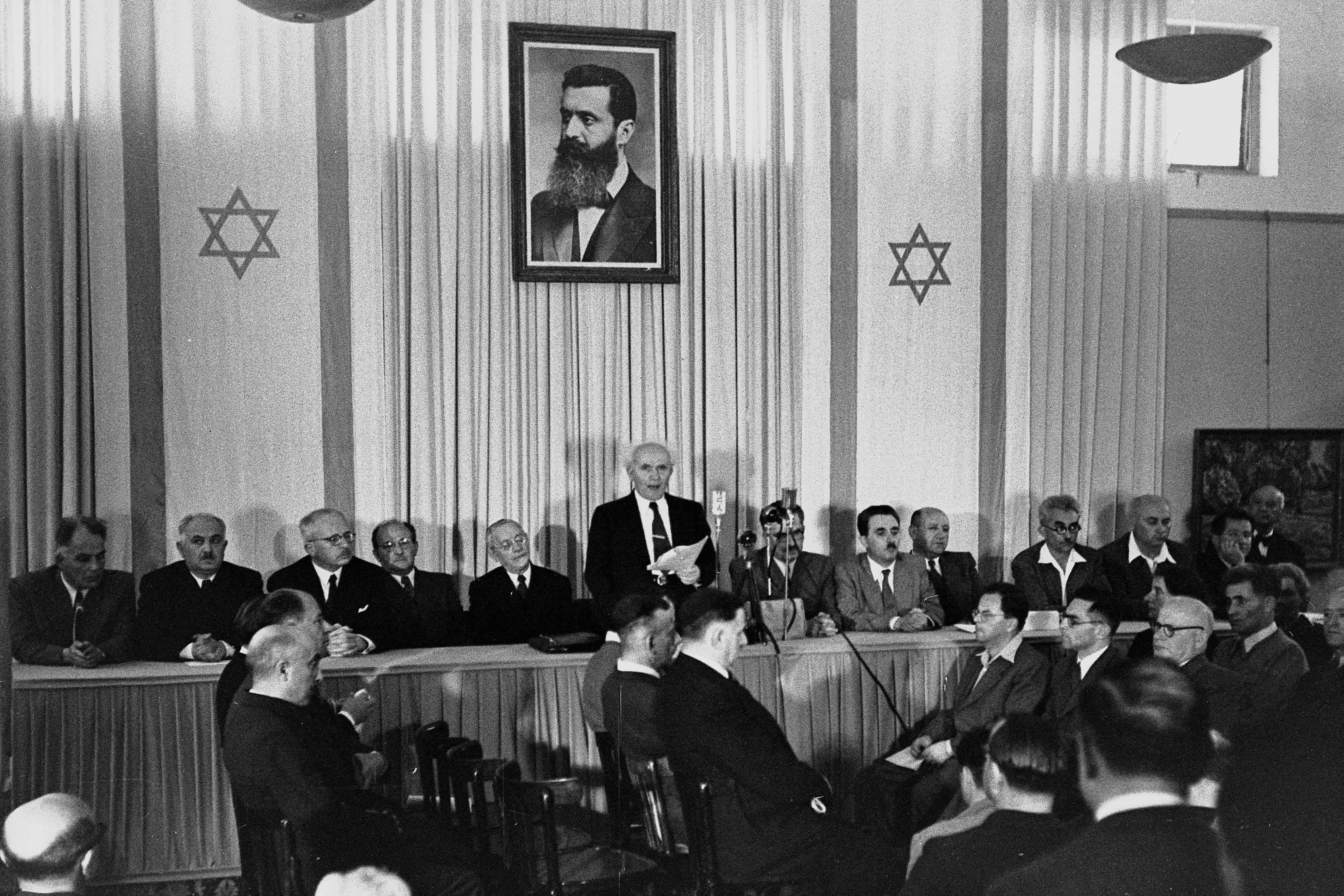
A people is not a passport. Jewish history is long. Continuity of Jews as a people through exile, liturgy, and return is real. Continuity of a people is still not continuity of the State of Israel. That state has a birthday: United Nations Resolution 181 (II) on 29 November 1947, and the Declaration of the Establishment of the State of Israel on 14 May 1948. There is no unbroken chain of prime ministers from Saul to Netanyahu.
Genetics does not turn Genesis into a citizenship test. Ancient DNA work on the Bronze Age southern Levant (often called Canaanite in the archaeological sense) finds that both many present-day Jewish groups and Levantine Arabic-speaking groups, including populations continuous with Palestinian communities, carry substantial ancestry related to people who lived in that region in the Bronze Age. Diaspora Jewish communities also show later admixture with host populations. Levantine Arabic-speaking groups show later admixture as well. The scholarly point is shared Levantine depth, not a single “true heir” passport.
So:
- Modern Israeli citizenship is a legal status created in 1948 and after. It is not identical to “the Israelites” of the Hebrew Bible.
- Jewish peoplehood is a real religious and historical continuity. It is not the same fact as Netanyahu’s government.
- Many Palestinians are ancestral to the same land in the ordinary population sense: families who stayed in the Levant across conquests, while Jewish communities also preserved identity in diaspora and return. Genetics supports deep local roots for both Jewish and Palestinian Levantine populations. It does not make one side the exclusive grammatical “thee” of Genesis 12.
Cruz’s democracy point does not repair the theology. A state can be elected and still not be the nation Genesis is discussing. The United States is a democracy. That does not make it the Israel of the patriarchs either.
Why that is not Christianity
Cruz is wrong because he calls a category error a Christian command.
- Genesis blesses Abram.
- Paul reads that blessing as a blessing of the nations.
- Cruz reads it as a duty to support the government headed by Benjamin Netanyahu, and says that government is what God meant, and that it has existed for thousands of years.
Each step leaves the text. The last leaves the calendar.
The political theology in its place is modern. Christian nationalism drapes a country’s power in biblical authority and treats support for that power as a test of faith. In this clip the country is Israel and the implied duty falls on American Christians. The tighter name for the Genesis move is Christian Zionism. The version that times wars toward Armageddon is dispensationalism, a nineteenth-century system (John Nelson Darby; later Scofield notes; popular books after 1948), not the message of Jesus or of Paul. The clip never uses those labels. The words Cruz does use are enough.
The war theology is a later package
The clip never says Armageddon. Attributing that word to Cruz or Carlson would be false. The connection still belongs to a real system: premillennial dispensationalism, which splits Israel and the church, expects a rapture and tribulation, and in later forms treats the State of Israel as God’s prophetic clock toward Armageddon (Revelation 16:16). Sean Durbin’s survey in the Critical Dictionary of Apocalyptic and Millenarian Movements tracks that history. Genesis 12 does not. Paul does not. The creeds do not.
A curse from Genesis is not a foreign-policy argument. It is a threat dressed as a memory verse, and a false account of Christianity.
Why Christian nationalism fails as faith and as public life
Here are the main arguments, said simply.
Theological and spiritual
- Distortion of the Gospel: Combining Christianity with political power replaces the Gospel’s love, humility, and service with a chase for worldly dominance.
- Idolatry: Treating a nation or party as God’s kingdom misrepresents Jesus.
- Persuasion over force: Jesus’s kingdom spreads by witness and voluntary conversion, not by government coercion. See analysis at The Gospel Coalition.
- Who counts as the church: Christian identity comes from faith in Christ, not from national citizenship. See the Christians Against Christian Nationalism statement.
Constitutional and religious freedom
- Separation of church and state: The U.S. Constitution does not establish a national religion and bans religious tests for office. Christian nationalism works against that framework.
- Threat to minority faiths: Preferential legal and cultural status for one religion pushes other faiths, or no faith, into a secondary civic class.
- Compromising religious liberty: Freedom for all religions needs government neutrality. When the state favors Christianity, liberty for everyone weakens.
Democratic and social
- Social hierarchies: Linking “true American” (or “true Christian ally”) to one racial, cultural, or narrow religious identity divides people and marginalizes immigrants, people of color, and minorities.
- Undermining democracy: When elections or institutions do not deliver preferred religious outcomes, this ideology often shows low regard for democratic process and slides toward authoritarian habits.
None of this, by itself, settles what any government should do next in the Middle East. A state founded in 1948 can be allied with, criticized, or opposed on ordinary grounds: law, civilians, security, history, power. What Genesis will not do is make that choice holy. Cruz offered a misquote as Christianity. It is not. It ought to be refused.
Sources
- ClassicClipsVault, “Tucker Carlson vs. Ted Cruz on Israel: Christian Zionism,” YouTube, 19 June 2025. Auto-generated captions, not a human transcript. https://www.youtube.com/watch?v=9M-S8hlJzTo
- Genesis 12:1–3, King James Version. https://www.blueletterbible.org/kjv/gen/12/1/
- Galatians 3:8, King James Version. https://www.blueletterbible.org/kjv/gal/3/8/
- The Society for Old Testament Study, “Pentateuch.” https://www.sots.ac.uk/wiki/pentateuch/
- Leningrad Codex, colophon dated 1008/9. Wikimedia Commons file record. https://commons.wikimedia.org/wiki/File:Leningrad_Codex_FULL.pdf
- United Nations General Assembly, Resolution 181 (II), 29 November 1947. https://documents.un.org/doc/resolution/gen/nr0/038/88/pdf/nr003888.pdf
- Declaration of the Establishment of the State of Israel, 14 May 1948, Avalon Project, Yale Law School. https://avalon.law.yale.edu/20th_century/israel.asp
- Rudi Weissenstein, Ben-Gurion reading the Declaration, 14 May 1948, Wikimedia Commons. https://commons.wikimedia.org/wiki/File:Declaration_of_State_of_Israel_1948.jpg
- Lily Agranat-Tamir et al., “The Genomic History of the Bronze Age Southern Levant,” Cell 181, no. 5 (2020): 1146–1157. https://www.cell.com/cell/fulltext/S0092-8674(20)30487-6
- Sean Durbin, “Dispensationalism,” Critical Dictionary of Apocalyptic and Millenarian Movements, 19 December 2022. https://www.cdamm.org/articles/dispensationalism
- Patrick Schreiner / The Gospel Coalition, “The Good, the Bad, and the Ugly of Christian Nationalism.” https://www.thegospelcoalition.org/article/good-bad-ugly-christian-nationalism/
- Christians Against Christian Nationalism, statement of principles (Baptist Joint Committee for Religious Liberty). https://www.christiansagainstchristiannationalism.org/statement
