Isaiah 45:7, the problem of evil, and the moral contradiction of a God who creates catastrophe.
Imagine a powerful ruler deliberately unleashing a catastrophe upon a city. Buildings collapse. Families are buried beneath rubble. Children die. Survivors wander through the wreckage, searching for loved ones.
When confronted, the ruler doesn’t deny responsibility. He proudly announces that he created the disaster.
We would call this person a monster. We might demand his arrest, removal from power, or prosecution for crimes against humanity.
But what if the person making that declaration were God?
Suddenly, we’re told, the rules change.
What would be an atrocity committed by a human becomes a mysterious act of divine wisdom. The victims become unfortunate participants in some cosmic plan. And anyone questioning the morality of the perpetrator is accused of arrogance.
The uncomfortable part?
The Bible actually portrays God as the creator of calamity.
Not Satan. Not merely human free will. God himself.
And one of the clearest declarations appears in Isaiah 45:7.
God’s surprisingly candid admission
The King James Version of Isaiah 45:7reads:
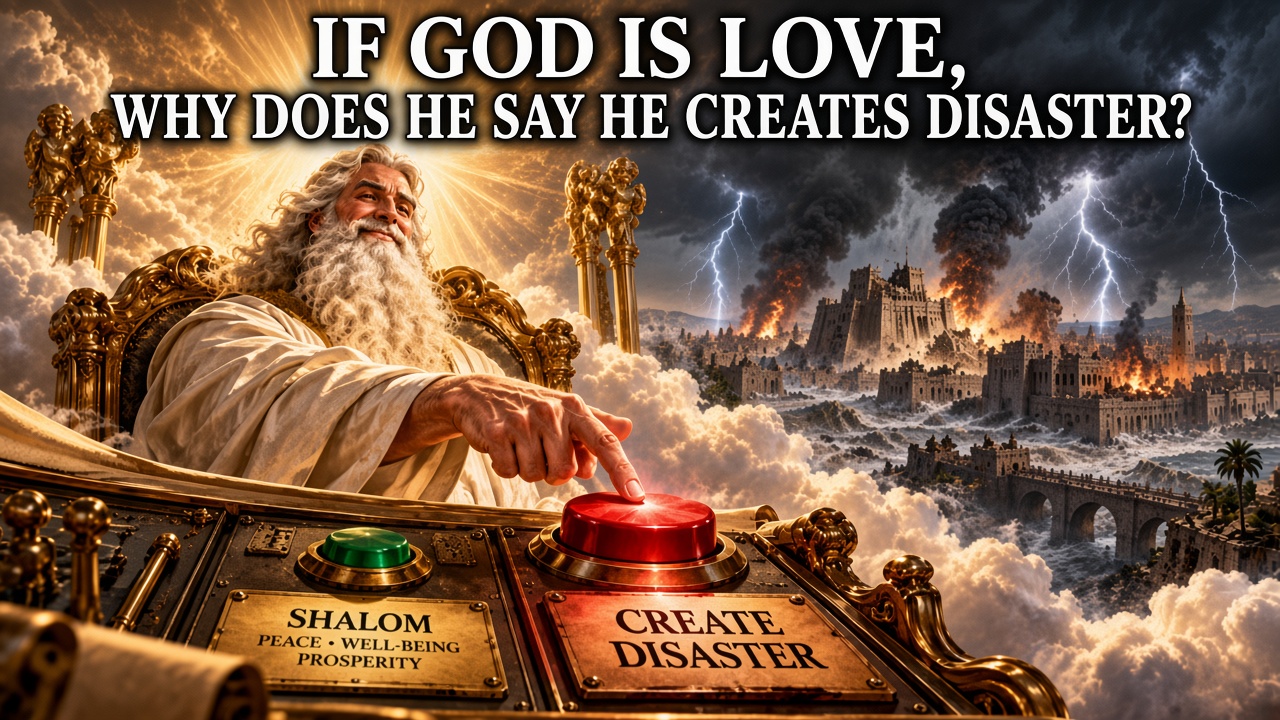
“I form the light, and create darkness: I make peace, and create evil: I the LORD do all these things.”
That’s quite a statement from the alleged source of perfect goodness.
Modern translations soften what English readers might understand by the word evil. The New International Version, for example, uses “create disaster.”
This difference has inspired considerable apologetic discussion. Christians are often quick to explain that the Hebrew word raʿ does not necessarily mean moral evil.
And they’re right.
The Hebrew raʿ can refer to moral wickedness, but also to calamity, adversity, misfortune, or harm. Its meaning depends on context.
In this verse, raʿ is contrasted with shalom, a word expressing peace, welfare, and well-being. The contrast strongly favors the meaning of calamity rather than moral wickedness.
That’s a legitimate linguistic distinction—not evidence that modern Bible translators are hiding something.
But here’s the problem.
The translation may rescue God from the accusation of creating moral wickedness. It does not rescue him from the accusation of creating suffering.
The theological defense becomes rather peculiar:
Don’t worry. God isn’t saying he creates evil. He’s only saying he creates disasters.
Well, that’s reassuring.
For the family trapped beneath the wreckage, the distinction may be less comforting than theologians imagine.
The Hebrew text and several English translations confirm that the verse assigns the creation of calamity to God. The moral implications remain open to examination.
What Isaiah was actually talking about
Historical context matters.
Isaiah 45 belongs to the portion of Isaiah commonly called Deutero-Isaiah, or Second Isaiah, generally associated by biblical scholars with the final period of the Babylonian exile and the rise of Persian power in the sixth century BCE.
The chapter refers to Cyrus the Great, the Persian ruler whose conquests transformed the ancient Near East. Cyrus conquered Babylon in 539 BCE.
Isaiah depicts Cyrus as an instrument of Yahweh, despite his not being a worshipper of Israel’s God.
The underlying theological claim is sweeping: Yahweh controls the destiny of nations. He brings prosperity and catastrophe, raises rulers and topples kingdoms.
The passage is not primarily a discussion of earthquakes or childhood diseases. It is a declaration of divine sovereignty over historical fortunes, including imperial conquest and national disaster.
That context is important because it prevents us from pretending the text is a general scientific explanation of natural disasters.
But it does not make the moral questions disappear.
Ancient conquest was not a harmless rearrangement of flags on a map. War, siege, displacement, destruction, and political collapse imposed terrible costs on ordinary people.
In the biblical writer’s worldview, such upheavals could be understood as acts within God’s sovereign plan.
From a skeptical historical perspective, however, this is a theological interpretation of ancient political events, not independent evidence that a supernatural being directed them.
And if the claim of divine control is accepted, it creates an immediate moral problem.
The difference between permitting disaster and creating it
The classical problem of evil is often presented through three characteristics traditionally attributed to God:
- God is all-powerful.
- God is all-knowing.
- God is perfectly good.
Yet the world contains extraordinary suffering.
If God knows about suffering, possesses the power to prevent it, and genuinely desires the well-being of his creatures, why does so much apparently unnecessary suffering exist?
Philosophers have debated versions of this question for centuries, from ancient arguments attributed to Epicurus through David Hume to contemporary philosophers such as J. L. Mackie and William Rowe.
But Isaiah 45:7introduces an especially uncomfortable feature.
The issue is no longer merely why God allows catastrophe. It is why God would deliberately bring it about.
There is a meaningful moral difference between failing to prevent a building from collapsing and intentionally demolishing it while people are inside.
Both situations can raise questions of responsibility. But deliberate causation carries a particularly heavy burden of justification.
If a human ruler intentionally caused widespread destruction, we would demand an exceptionally compelling reason.
Why should the moral standard become weaker simply because the alleged perpetrator is divine?
If anything, an omnipotent and omniscient being should be held to a higher standard. Unlike human decision-makers, such a being would face no shortage of information, no inability to anticipate consequences, and no apparent limitation in finding alternatives.
A limited human being might genuinely be forced to choose between terrible outcomes.
What forces an all-powerful God to make that choice?
The victims who never seem to matter in the explanation
Religious explanations for catastrophe often emphasize divine justice, punishment, redemption, or an ultimate greater good.
But these explanations frequently overlook the people crushed between the theological gears.
Consider a city destroyed during a military campaign.
Its inhabitants are not collectively responsible for every decision made by their rulers. A newborn has committed no political offense. A child cannot be held morally accountable for the religious commitments of an empire.
Yet collective disasters do not discriminate according to individual moral responsibility.
The Bible itself repeatedly portrays destruction on an enormous scale.
In Genesis, the flood destroys nearly all land-dwelling human and animal life outside the ark.
In Exodus, the death of Egypt’s firstborn is presented as an act of divine judgment.
In 2 Samuel 24, a plague kills 70,000 people following David’s census.
These narratives are not all identical to Isaiah 45:7, and each has its own literary and historical context. Nevertheless, they reinforce a recurring biblical theme: God sometimes causes or commands destructive events that affect people far beyond the individual supposedly responsible for an offense.
From an atheist moral perspective, that is deeply disturbing.
We would not excuse a human general who punished an entire civilian population for the misconduct of its leader.
We would not call a parent loving for deliberately killing several children to punish another child’s disobedience.
And we would not regard mass death as evidence of perfect justice merely because the person causing it claimed unquestionable authority.
So why make an exception for God?
The greater-good defense: Could God have found a better way?
One common response is that God allows or causes suffering to produce a greater good.
Perhaps calamity encourages moral growth, corrects injustice, restores a nation, or contributes to purposes beyond human comprehension.
This is a serious philosophical argument, not something that can be dismissed merely by mocking it.
Sometimes, even in ordinary human experience, causing limited suffering can be morally justified. A surgeon may cause pain to save a life. A firefighter may demolish part of a building to prevent a larger catastrophe.
But those comparisons reveal precisely what makes the divine case problematic.
A surgeon operates within biological constraints. A firefighter confronts physical dangers beyond personal control.
An omnipotent creator supposedly designed the entire system.
If God can accomplish anything logically possible, why establish a world in which innocent suffering is necessary to achieve desirable outcomes?
Why would moral development require children to die?
Why should justice demand collective destruction rather than individualized accountability?
Why must divine instruction arrive in the form of devastation rather than understanding?
The believer may propose that some indispensable good remains hidden from us.
That possibility cannot be ruled out by definition. But neither can it simply be assumed.
An imaginable justification is not the same thing as an established justification.
The atheist is not required to prove that absolutely no possible divine explanation exists. The evidential problem of evil asks whether the actual scale, intensity, and distribution of suffering are what we should reasonably expect from a perfectly good creator.
Philosopher William Rowe famously developed this form of argument, focusing on suffering that appears to serve no morally sufficient purpose.
Isaiah 45:7adds a specifically biblical difficulty: the text does not merely portray God as allowing misfortune within a flawed world. It celebrates his sovereignty over the creation of calamity itself.
God’s mysterious ways: The ultimate escape clause?
Another familiar response is that human beings simply cannot understand God’s reasons.
Our knowledge is limited. God’s knowledge is infinite. Therefore, what appears cruel to us might be perfectly justified from a divine perspective.
In contemporary philosophy of religion, related approaches are discussed under the heading skeptical theism.
There is a legitimate insight here: failing to identify a sufficient reason for an event does not logically prove that no such reason exists.
But this defense creates another problem.
If we cannot evaluate God’s actions according to recognizable moral principles, on what basis do we declare God good?
Suppose a catastrophe occurs.
If people survive, God receives credit for a miracle.
If thousands die, God’s wisdom is said to transcend human understanding.
If prayers are answered, God is loving.
If prayers go unanswered, God has a mysterious plan.
This approach risks making the proposition that God is good immune to any possible counterevidence.
Whatever happens, God’s goodness remains the conclusion.
That is not a compelling method of moral evaluation. It is an assumption protected from criticism.
And if we abandon human moral understanding whenever divine conduct is questioned, we risk making the word good almost meaningless.
What does divine goodness actually mean if it remains compatible with any conceivable amount of deliberate suffering?
Is something good simply because God does it?
This problem resembles the ancient philosophical challenge known as the Euthyphro dilemma, originally developed in Plato’s discussion of piety and later applied to divine-command ethics.
Is an action good because God wills it?
Or does God will it because it is good?
If something is good merely because God commands it, then morality risks becoming arbitrary. Cruelty, collective punishment, or destruction could theoretically become virtuous simply through divine authorization.
But if God commands what is good because goodness is morally meaningful, then God’s actions remain subject to rational ethical assessment.
Theologians have developed sophisticated alternatives to this simple dilemma, including accounts that ground goodness in God’s necessarily good nature.
Yet that response does not end the discussion.
It still leaves us asking how we determine that the nature being described is good in the first place.
Simply defining God as perfectly good does not establish that every action attributed to him is morally justified.
A definition cannot substitute for a moral argument.
The atheist explanation requires fewer cosmic excuses
There is another way to understand Isaiah 45:7.
Perhaps it reflects the worldview of ancient people trying to make sense of war, exile, national defeat, and unexpected liberation.
In that world, divine sovereignty provided an explanation for historical events. If an empire conquered another, God could be credited with raising it. If a nation suffered, divine judgment could be invoked. If deliverance arrived, divine favor supplied the explanation.
This interpretation does not require us to accept that God actually caused the disasters.
It requires us to recognize that ancient religious authors attributed historical developments to divine agency.
From a naturalistic perspective, wars emerge from political ambitions, economic pressures, military capabilities, and human decisions. Earthquakes result from geological processes. Diseases develop and spread through biological mechanisms.
These processes can be investigated without assuming supernatural intervention.
That does not mathematically disprove every possible god. Nor does it settle every philosophical question about why the universe exists.
But it provides an account of suffering that does not require us to reconcile indiscriminate devastation with the intentions of a perfectly loving cosmic ruler.
The universe may be indifferent to our suffering.
That is an uncomfortable thought.
But perhaps it is more intellectually defensible than insisting that every tragedy somehow expresses perfect love.
So who is responsible when God creates disaster?
Isaiah 45:7makes a remarkably direct theological claim. God brings about both well-being and calamity.
The historical context helps explain why an ancient biblical author would say this.
The Hebrew clarifies that the passage is not necessarily about creating moral wickedness.
Neither observation resolves the central moral issue.
If a perfectly loving God deliberately creates disaster, what justifies the suffering of the innocent?
If the answer is justice, why does collective catastrophe so often ignore individual responsibility?
If the answer is a greater good, why couldn’t an all-powerful creator accomplish that good without devastating people?
If the answer is mystery, how can we confidently describe the author of that mystery as morally perfect?
And if the answer is simply that whatever God does must be good, haven’t we stopped evaluating goodness altogether?
Isaiah 45:7does not disprove God’s existence. A verse in an ancient religious text could not accomplish that by itself.
But it exposes an uncomfortable tension between the Bible’s portrayal of divine sovereignty and the modern theological insistence that God is perfectly loving.
The skeptical position is not that suffering always proves malevolence. It is that extraordinary claims about perfect goodness require moral justification, particularly when the supposed agent is credited with creating catastrophe.
When a human deliberately causes destruction, we demand accountability. When God is said to cause destruction, we’re told to offer worship.
The question is not whether God would possess the power to create disaster.
The question is why possessing that power should make the act morally good.
And perhaps the most revealing part of Isaiah 45:7isn’t that God takes credit for creating disaster.
It’s how quickly people rush to explain why he shouldn’t be held responsible for it.
Sources and further reading
- Isaiah 45:7, Hebrew text and lexical analysis, Bible Hub.
- Isaiah 45:7, comparative translations, Bible Gateway.
- Dalit Rom-Shiloni, “Exile in the Book of Isaiah,” in The Oxford Handbook of Isaiah, ed. Lena-Sofia Tiemeyer (Oxford University Press, 2020), doi:10.1093/oxfordhb/9780190669249.013.17.
- Christopher B. Hays, “The Book of Isaiah in Contemporary Research,” Religion Compass 5, no. 10 (2011): 549–566, doi:10.1111/j.1749-8171.2011.00308.x.
- William L. Rowe, “The Problem of Evil and Some Varieties of Atheism,” American Philosophical Quarterly 16, no. 4 (1979): 335–341, JSTOR.
- Stanford Encyclopedia of Philosophy, “The Problem of Evil” and “Skeptical Theism.”
- Plato, Euthyphro, for the classical question concerning the relationship between divinity and goodness (Project Gutenberg, Jowett translation).