
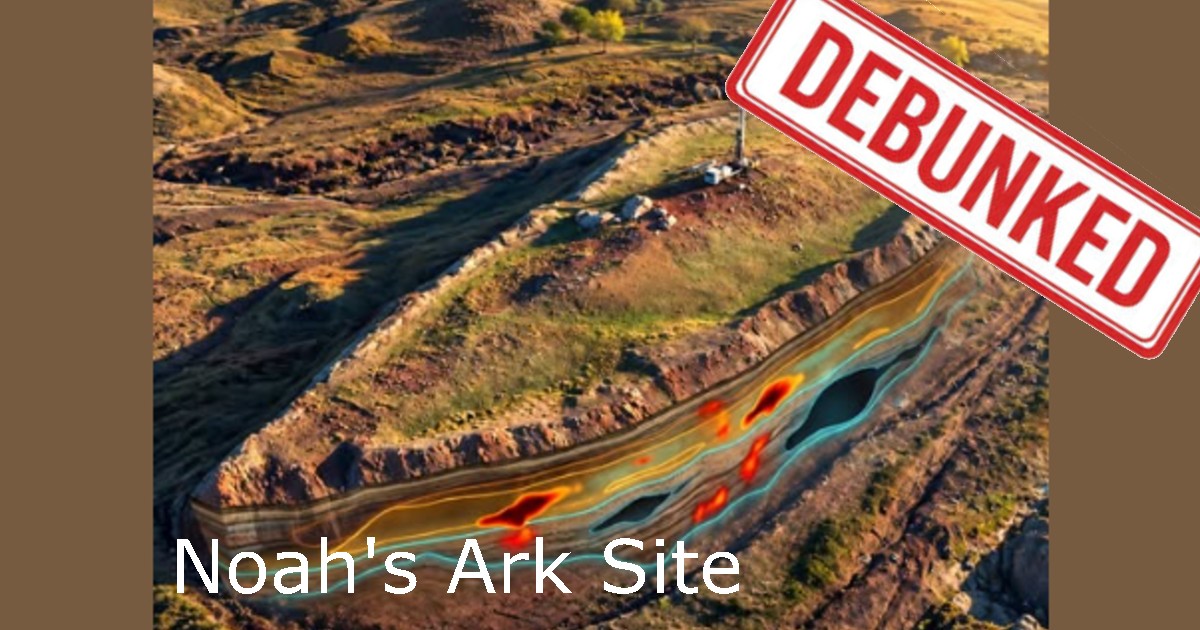
The Durupınar site in Turkey is a natural geological formation that happens to have a vaguely boat-like outline. That is the entire foundation of the claim.
A boat shape is not a boat. Nature produces familiar shapes constantly. Faces in cliffs are not statues. Animal-shaped clouds are not animals. And a ship-shaped ridge is not automatically a Bronze Age vessel.
The dramatic colored lines added to images do not change that.
Ground-penetrating radar does not produce a photograph of a buried ship. It detects differences beneath the surface. Rock layers, fractures, moisture, faults, and sediment boundaries can all create radar anomalies.
Calling those anomalies “walls,” “decks,” or “rooms” does not make them walls, decks, or rooms.
That is interpretation, not discovery.
Actual archaeological evidence would be much harder to dismiss. Investigators would need things like worked timber, constructed joints, fasteners, tools, artificial structural remains, or some unmistakable part of a manufactured hull.
That evidence has not been demonstrated.
Even several supposed pieces of evidence promoted over the years have turned out to be ordinary geology. Alleged metal fittings have been explained as naturally occurring mineral concentrations. Alleged petrified wood has been identified as rock. Supposed anchor stones are local volcanic stones.
Apparently Noah was thoughtful enough to construct his enormous ship entirely out of materials that look exactly like the surrounding geology.
The site has also been studied by geologists who concluded that its shape can be explained through folded sedimentary rock, erosion, and related geological processes.
Even some creationist researchers reject Durupınar as Noah’s Ark.
That should tell you something.
The most embarrassing detail is that David Fasold, once one of the site’s major promoters, later participated in geological research that supported a natural explanation for the formation.
So when you see another viral image covered in glowing outlines announcing “NOAH’S ARK FOUND,” notice what is usually missing:
No excavated ship.
No demonstrated wooden hull.
No ancient construction.
No verified artifacts from a vessel.
No independently confirmed archaeological structure.
Just a boat-shaped geological formation with colorful lines drawn over it.That is not archaeology.
Scientific Evaluation of the Durupınar Formation
The Durupınar formation has been investigated repeatedly since its identification in aerial photographs in 1959. The relevant geological literature has not established that the structure is an archaeological vessel. Instead, published studies have explained its morphology through natural geological processes.
1960 — Initial Field Investigation
An expedition organized after the 1959 aerial photographs examined the formation in 1960. The investigators found no identifiable archaeological remains and concluded that the site did not provide evidence of a constructed vessel. Importantly, the expedition did not include a geologist, so this was primarily an initial archaeological reconnaissance rather than a detailed geological investigation.
1976–1981 — Early Geological Assessments
Geologist Clifford Burdick and archaeologist William H. Shea discussed the formation in creationist scientific literature during the 1970s and early 1980s. Burdick interpreted the structure geologically rather than as an obvious archaeological hull, describing it in terms of natural deformation or uplift within the surrounding volcanic and sedimentary environment. Shea’s 1981 review likewise acknowledged that the formation presented primarily a geological problem and noted the absence of archaeological evidence from the original investigation.
1980s–Early 1990s — Geophysical and Core Investigations
During the renewed investigations associated with Ron Wyatt, David Fasold, John Baumgardner and others, the site was examined using metal detection, ground-penetrating radar, seismic methods, magnetometry and drilling.
Some investigators initially interpreted anomalies as evidence of internal structure. Subsequent geological investigations, however, found that the subsurface features could be accounted for by natural rock layers and geological discontinuities. Core drilling reportedly encountered natural rock stratigraphy rather than artificial structural material.
1996 — Collins and Fasold
The most important published geological critique is:
Lorence G. Collins and David F. Fasold, “Bogus ‘Noah’s Ark’ from Turkey Exposed as a Common Geologic Structure,” Journal of Geoscience Education 44, no. 4 (1996): 439–444.
Collins and Fasold concluded that Durupınar was a natural geological structure. They interpreted its geometry in terms of steeply inclined sedimentary strata and a doubly plunging synclinal configuration.
They also examined several alleged archaeological materials. Purported iron fittings were identified with naturally occurring iron-rich minerals, while material described as petrified wood was identified as geological rather than botanical. The authors likewise rejected the claim that nearby perforated stones demonstrated the presence of ancient ship anchors.
The significance of Fasold’s participation is considerable because he had previously been one of the principal advocates of the Durupınar-Ark identification.
2007 — Murat Avcı
A second important geological interpretation was published by Turkish engineering geologist Murat Avcı:
Murat Avcı, “‘Noah’s Ark’: Its Relationship to the Telçeker Earthflow, Mount Ararat, Eastern Turkey,” Bulletin of Engineering Geology and the Environment 66 (2007): 377–380.
Avcı interpreted the ship-shaped formation as a large displaced block of Miocene limestone associated with the Telçeker earthflow. Its present morphology was explained through mass movement, erosion, abrasion and dissolution rather than artificial construction.
This differs in detail from the Collins-Fasold interpretation but reaches the same fundamental conclusion: the formation can be explained geologically without invoking a buried ship.
2016 — Collins Reassessment
Geologist Lorence Collins revisited the Durupınar evidence in:
Lorence G. Collins, “Noah’s Ark near Dogubayazit, Turkey?” Perspectives on Science and Christian Faith 68, no. 4 (2016): 218–228.
Collins reviewed the site’s geology, mineralogy and alleged artifacts in greater detail. He again concluded that the supposed structural remains—including alleged iron fittings and petrified wood—were naturally occurring geological materials and that erosion and mass movement adequately explained the site’s morphology.
Summary of Geological Findings
Across several decades, different investigators have proposed somewhat different mechanisms for the exact development of the Durupınar formation. These include folding of sedimentary strata, landslide displacement, earthflow processes, differential erosion and dissolution.
That scientific disagreement concerns how the natural formation developed, not whether a manufactured wooden hull has been demonstrated.
No published geological investigation has established diagnostic shipbuilding features such as worked structural timber, joinery, manufactured fasteners, hull architecture or archaeological material demonstrably belonging to an ancient vessel.
The principal published geological studies instead identify Durupınar as a naturally produced geological formation.
Sources
Collins, Lorence G., and David F. Fasold. “Bogus ‘Noah’s Ark’ from Turkey Exposed as a Common Geologic Structure.” Journal of Geoscience Education 44, no. 4 (1996): 439–444.
Avcı, Murat. “‘Noah’s Ark’: Its Relationship to the Telçeker Earthflow, Mount Ararat, Eastern Turkey.” Bulletin of Engineering Geology and the Environment 66 (2007): 377–380.
Collins, Lorence G. “Noah’s Ark near Dogubayazit, Turkey?” Perspectives on Science and Christian Faith 68, no. 4 (2016): 218–228.
Shea, William H. “A Review of Recent Data from the Region of the Ark-Shaped Formation in the Tendurek Mountains of Eastern Turkey.” Origins 8, no. 2 (1981): 77–95.
Burdick, Clifford L., and related discussion in William H. Shea, “The Elliptical Formation in the Tendurek Mountains,” Creation Research Society Quarterly (1976).