Here is a tighter version that keeps the provocative tone while making the chronology and pseudonymous writings clearer.
Who Told Matthew That?
The Four Gospels Were Not Written by Four Eyewitnesses
Imagine finding four ancient biographies of a famous king.
None names its author.
None claims to be written by an eyewitness.
One appears to copy another.
A third rewrites the earlier account for a different audience.
And generations later, church tradition supplies the names of famous associates of the king.
Would you call those four independent eyewitness biographies?
Probably not.
Yet that is remarkably close to what we find with the canonical Gospels.
The names Matthew, Mark, Luke, and John appear so naturally on our Bibles that it is easy to forget something fundamental:
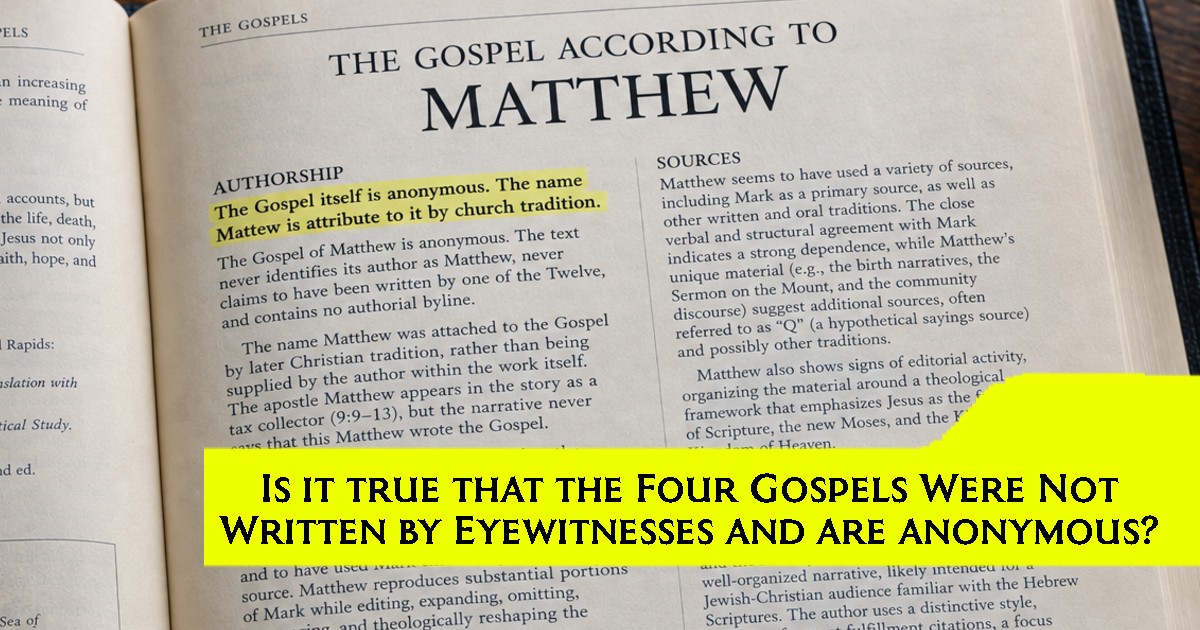
the four Gospels never identify their authors by those names.
Matthew does not say, “I am Matthew.”
Mark does not say, “I am Mark.”
Luke does not say, “I am Luke.”
John does not say, “I am John the apostle.”
The texts themselves are anonymous.
Start With the Clock
The earliest surviving Christian writings are not the Gospels.
They are the undisputed Pauline letters, generally dated to roughly the 50s CE, decades before the canonical Gospels.
Paul is therefore our earliest substantial Christian literary witness.
But Paul’s letters are not biographies of Jesus. They are letters written to Christian communities dealing with theology, disputes, ethics, salvation, scripture, and the significance of Jesus’ death and resurrection.
Paul preserves some traditions about Jesus, but he doesn’t give us anything resembling the later Gospel biographies.
And even the New Testament’s Pauline collection demonstrates another important ancient phenomenon: several letters attributed to Paul are widely regarded by modern scholars as later pseudonymous writings, including Ephesians, Colossians, and the Pastoral Epistles. Hebrews was also later associated with Paul despite being anonymous.
The same phenomenon occurs elsewhere.
2 Peter, traditionally attributed to Peter, is widely regarded by modern scholarship as pseudonymous and considerably later than the historical Peter.
So the New Testament itself gives us examples where a famous apostolic name became attached to a text that many historians do not believe was actually written by that apostle.
That doesn’t prove the Gospel attributions are false.
But it certainly means we shouldn’t assume that an ancient title automatically establishes authorship.
Then Comes Mark
Most historical-critical scholars place Mark around the time of the Jewish War, roughly 65–75 CE.
Under the dominant Markan-priority model, Mark is the earliest Gospel and Matthew and Luke subsequently use it as a major literary source.
Think about what that means.
Instead of:
Matthew → independent eyewitness
Mark → independent eyewitness
Luke → independent eyewitness
we get something closer to:
Mark
↓
Matthew and Luke rewrite Mark
Matthew and Luke don’t merely tell similar stories. They share substantial wording, sequence, episodes, and narrative structure with Mark.
They also modify the material.
They add things.
They remove things.
They rearrange things.
They emphasize different theology.
The exact relationship between Matthew and Luke remains debated, including the famous hypothetical source Q, but the larger literary problem remains: the Synoptic Gospels are deeply interconnected.
This looks considerably more like successive authors shaping inherited traditions than four independent eyewitnesses writing four reports.
Who Told Matthew That?
Now consider the narrative itself.
The Gospel authors tell us what Jesus said and did in private.
They describe conversations away from the crowds.
They sometimes reveal what characters think.
They tell us what happens when nobody in the story appears to be recording anything.
So ask the deliberately annoying question:
Who told Matthew that?
Who was taking notes when Jesus was alone?
Who recorded the private conversation?
Who knew exactly what Jesus prayed?
Who supplied the precise wording of conversations between characters when no identifiable witness is present?
This doesn’t prove the scenes are fictional.
It demonstrates something more basic:
These are literary narratives, not stenographic transcripts.
Ancient authors could construct dialogue, arrange scenes, reveal private information, and shape stories around theological themes. We therefore cannot simply assume that every speech in a Gospel is a verbatim eyewitness quotation.
And Then Comes John
John makes the problem even harder.
Compare John’s Jesus with Mark’s Jesus.
Mark gives us short sayings, parables, aphorisms, dramatic encounters, and the mysterious suffering Messiah.
John gives us long theological discourses and repeated declarations about Jesus’ heavenly origin, divine relationship, eternal life, and identity.
These aren’t simply four cameras pointed at the same event.
They are four literary portraits shaped by different authors and communities.
So Where Did the Names Come From?
This is where tradition enters.
The Gospels themselves don’t tell us who wrote them.
Early Christian writers later discuss figures named Matthew, Mark, Luke, and John, and by the later second century Irenaeus explicitly identifies the four canonical Gospels with those names.
The names therefore became authoritative through church tradition and external attribution, not because each Gospel contains an author’s signature.
This distinction matters.
“Matthew wrote this” is one claim.
“Later Christians attributed this anonymous Gospel to Matthew” is another.
The historian has to investigate the second claim before accepting the first.
And ancient Christianity provides plenty of reasons for caution: writings circulated under famous apostolic names, some of which modern scholars consider pseudonymous.
The Historical Picture Is Stranger Than the Sunday-School Version
The surviving evidence does not look like:
Jesus → four eyewitnesses → four signed biographies
It looks more like:
Jesus movement
↓
oral traditions and competing interpretations
↓
Paul’s early letters
↓
Mark
↓
Matthew and Luke reshape earlier material
↓
John develops a very different literary portrait
↓
later Christian tradition attributes the anonymous Gospels to famous figures
↓
the Church canonizes them as authoritative
That doesn’t settle every question about the historical Jesus.
It does something more important:
It changes the question.
Instead of assuming that Matthew, Mark, Luke, and John were four independent eyewitness reporters, we have to ask:
Who actually wrote these anonymous narratives?
What earlier traditions did they use?
Why did they change them?
Who were they writing for?
And why did later Christians attach apostolic names to them?
And perhaps the most irritating question of all:
Who Told Matthew That?
Because if Matthew really was an eyewitness apostle, the historian still has to explain why his Gospel appears to depend so heavily on an earlier anonymous narrative.
That’s not an argument against Christianity.
It’s an argument for actually doing history.
Scholarly Sources in Brief
- Simon J. Gathercole, “The Alleged Anonymity of the Canonical Gospels” — Argues against the simple claim that the Gospels were necessarily anonymous in the historical sense, maintaining that the traditional attributions may have been attached to the texts very early.
- Stephen C. Carlson, “The Imposition of Authorship” — Examines Mark’s anonymity and the development of the attribution to Mark through Papias and later Christian writers. Particularly useful for distinguishing the text itself from the later identification of its author.
- John S. Kloppenborg, “On Dispensing with Q?” — Examines the Synoptic Problem and the competing explanations for the relationship between Matthew and Luke, including whether Luke knew Matthew directly or whether both used additional sources.
- Mark Goodacre, The Synoptic Problem — Presents the case for Markan priority and argues that Luke used Matthew rather than relying upon the hypothetical Q document.
- Raymond E. Brown, An Introduction to the New Testament — A comprehensive academic treatment of authorship, dating, sources, literary relationships, and the historical development of the New Testament.
- Bart D. Ehrman, The New Testament: A Historical Introduction — Provides a historical-critical overview of the New Testament, including anonymous Gospels, Markan priority, pseudonymous writings, and the development of Christian traditions.
- Bart D. Ehrman, Forged — Examines ancient Christian writings attributed to apostles and argues that several New Testament books were written in the names of figures who did not actually compose them, including writings attributed to Paul and Peter.
- Adela Yarbro Collins, Mark: A Commentary — Treats Mark as an ancient literary and theological narrative, examining its historical setting, sources, structure, and literary techniques.
- Joel Marcus, Mark — Provides detailed historical-critical analysis of Mark’s narrative construction, Jewish context, theology, and relationship to earlier traditions.
- John S. Kloppenborg, Q, the Earliest Gospel — Explores the hypothetical Q source reconstructed from material Matthew and Luke share that is absent from Mark.
- Graham Stanton, A Gospel for a New People — Examines Matthew’s literary and theological development and his relationship to earlier Christian traditions, particularly Mark.
- Bruce M. Metzger & Bart D. Ehrman, The Text of the New Testament — A foundational study of textual transmission, manuscript variants, scribal alterations, and the complicated history of how New Testament texts were copied.
- David C. Parker, An Introduction to the New Testament Manuscripts and Their Texts — Examines the manuscript evidence and explains why the text available today is the result of a long transmission history rather than an untouched original document.
- James D. G. Dunn, Jesus Remembered — Examines how traditions about Jesus were transmitted through early Christian communities, emphasizing the role of collective memory rather than assuming modern-style written biographies from eyewitnesses.
- Dale C. Allison Jr., Constructing Jesus — Critically examines attempts to reconstruct the historical Jesus and demonstrates how historical memory, interpretation, and theological assumptions complicate the process.
- Paula Fredriksen, Jesus of Nazareth, King of the Jews — Places Jesus within the political, religious, and Jewish environment of first-century Palestine and critically evaluates the Gospel narratives as historical evidence.
- Chris Keith & Anthony Le Donne, eds., Jesus, Criteria, and the Demise of Authenticity — Challenges simplistic methods for deciding which individual Gospel sayings are “authentic,” emphasizing how difficult it is to separate historical Jesus traditions from later interpretation.
- Chris Keith, Jesus Against the Scribal Elite — Investigates Jesus traditions within the context of literacy, scribal culture, and oral transmission rather than treating the Gospels as straightforward eyewitness documents.
- Richard Bauckham, Jesus and the Eyewitnesses — An important counterargument. Bauckham argues that eyewitness testimony played a much larger role in the Gospel traditions than many critical scholars assume. It is useful precisely because it presents the strongest scholarly case against an overly skeptical interpretation.
- Maurice Casey, Jesus of Nazareth — Attempts to reconstruct the historical Jesus using critical historical methods while arguing that significant historical information survives beneath the later Gospel narratives.
- Anthony Le Donne, Historical Jesus — Explores how historical memory works and argues that historians should understand Gospel traditions as interpreted memories rather than expecting perfectly preserved transcripts.
Taken together, these works support a much more complicated picture than the traditional “four eyewitnesses independently wrote four biographies” model: early Pauline correspondence comes first, the Gospels emerge later, Markan priority provides a strong case for literary dependence among the Synoptics, several New Testament writings appear to have been written under apostolic names, and the Gospels must be analyzed as ancient literary narratives shaped by memory, theology, sources, and communities.
Sources
- Simon J. Gathercole, “The Alleged Anonymity of the Canonical Gospels,” Journal of Theological Studies 69.2 (2018): 447–476.
- Stephen C. Carlson, “The Imposition of Authorship: Michel Foucault’s Author-Function and Papias of Hierapolis on the Gospel of Mark,” Harvard Theological Review (2025).
- John S. Kloppenborg, “On Dispensing with Q?: Goodacre on the Relation of Luke to Matthew,” New Testament Studies 49.2 (2003): 210–236.
- Mark Goodacre, The Synoptic Problem: A Way Through the Maze.
- Raymond E. Brown, An Introduction to the New Testament.
- Bart D. Ehrman, The New Testament: A Historical Introduction to the Early Christian Writings.
- Bart D. Ehrman, Forged: Writing in the Name of God—Why the Bible’s Authors Are Not Who We Think They Are.
- Adela Yarbro Collins, Mark: A Commentary.
- Joel Marcus, Mark 1–8, Anchor Yale Bible.
- Joel Marcus, Mark 8–16, Anchor Yale Bible.
- John S. Kloppenborg, Q, the Earliest Gospel: An Introduction to the Original Stories and Sayings of Jesus.
- Graham Stanton, A Gospel for a New People: Studies in Matthew.
- David C. Parker, An Introduction to the New Testament Manuscripts and Their Texts.
- Bruce M. Metzger and Bart D. Ehrman, The Text of the New Testament: Its Transmission, Corruption, and Restoration.
- Richard Bauckham, Jesus and the Eyewitnesses: The Gospels as Eyewitness Testimony.
- Michael F. Bird, The Gospel of the Lord: How We Know the Gospel Writers Were Telling the Truth.
- James D. G. Dunn, Jesus Remembered.
- Maurice Casey, Jesus of Nazareth: An Independent Historian’s Account of His Life and Teaching.
- Paula Fredriksen, Jesus of Nazareth, King of the Jews.
- Dale C. Allison Jr., Constructing Jesus: Memory, Imagination, and History.
- Chris Keith and Anthony Le Donne, eds., Jesus, Criteria, and the Demise of Authenticity.
- Chris Keith, Jesus Against the Scribal Elite: The Origins of the Conflict.
- Anthony Le Donne, Historical Jesus: What Can We Know and How Can We Know It?