
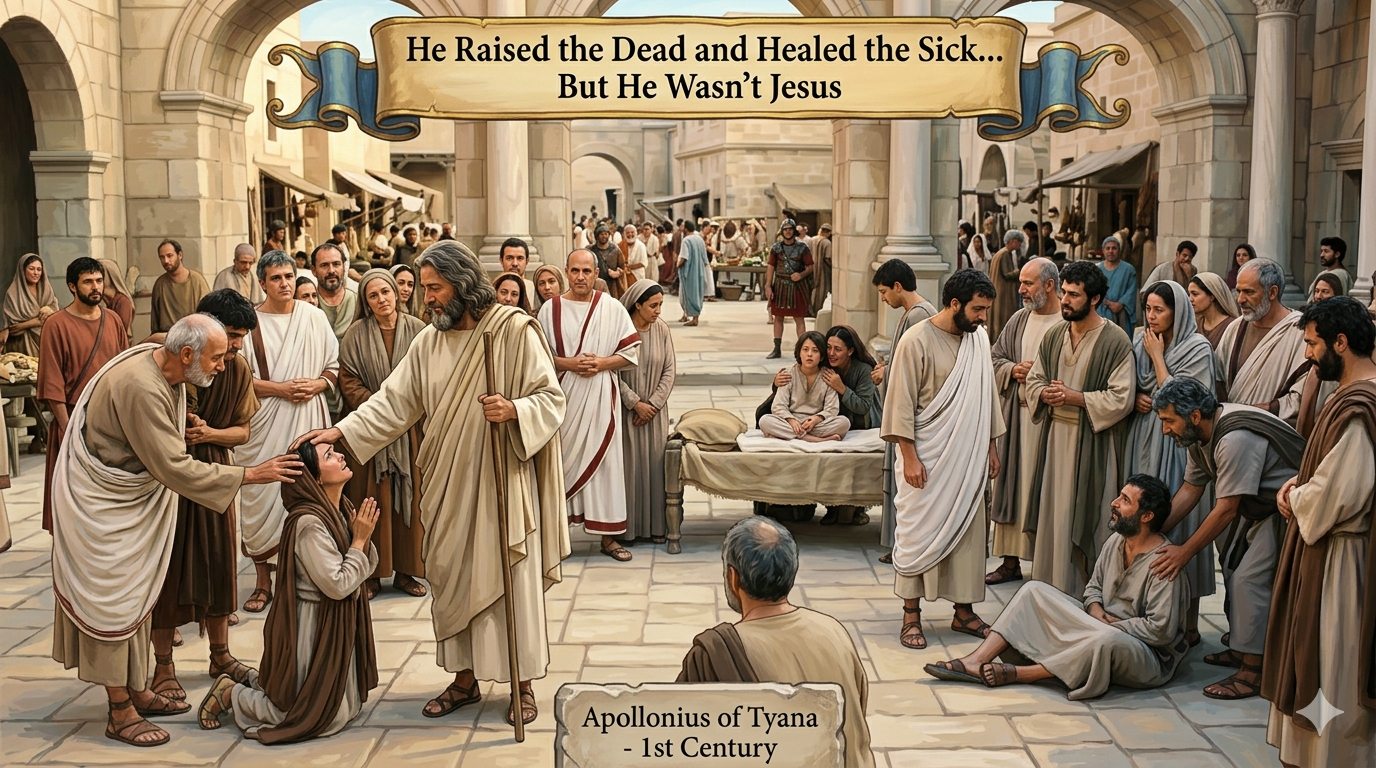
What if there was another miracle worker—living in the same century as Jesus Christ, moving through the same Roman world, teaching, gathering followers, and performing the same kinds of miracles?
A man who healed the sick.
Cast out demons.
Raised the dead.
Was revered by those who encountered him.
And yet—his name is barely remembered.
Not because his story lacked power… but because it never became doctrine.
His name was Apollonius of Tyana.
The figure of Apollonius of Tyana is preserved primarily through later biographies, most notably Life of Apollonius of Tyana. In these accounts, he is portrayed as a traveling teacher, philosopher, and miracle worker operating within the same broader Roman world often associated with Jesus Christ. What stands out is not just his presence, but the striking similarity between the types of actions attributed to both figures.
Apollonius Raising the Dead
Accounts of Apollonius of Tyana include a story in which he encounters a funeral procession and restores a young girl to life simply by touching her. The act is presented as immediate and without ritual, emphasizing authority rather than method. A closely parallel tradition appears in the Gospel of Mark, where Jesus Christ raises Jairus’s daughter with a direct command. In both accounts, death is not treated as final, and restoration occurs through a brief, decisive action—highlighting the perceived authority of the figure rather than any visible process
“He touched the girl… and she returned to life.” – Life of Apollonius of Tyana 4.45
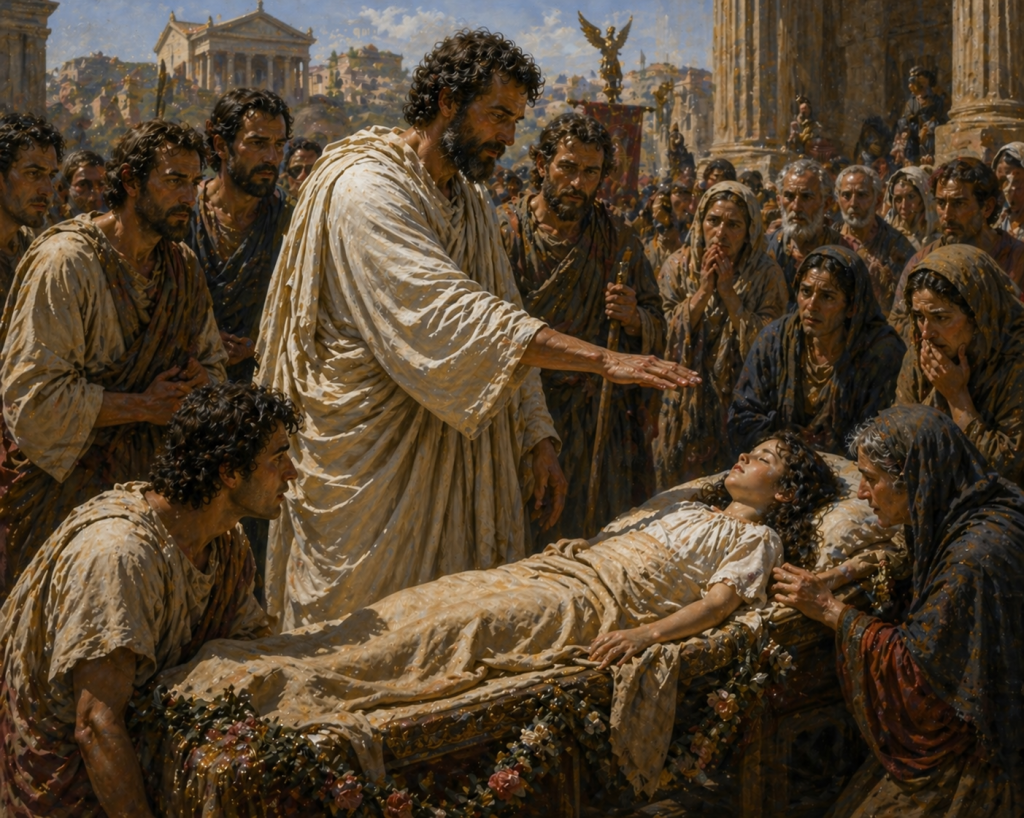
Apollonius is described as healing the sick, casting out unseen forces, and even restoring life to the dead. One account describes him encountering a funeral procession and reviving a young girl simply by touching her. This parallels scenes in texts like the Gospel of Mark, where Jesus raises Jairus’s daughter with a spoken command. In both traditions, the act is immediate, direct, and performed without elaborate ritual emphasizing authority rather than technique
“Little girl, I say to you, arise.”
— Gospel of Mark 5:41
Apollonius Healing the Sick
Descriptions of Apollonius frequently portray him as a healer sought out by crowds suffering from illness and affliction. Those who approach him are depicted as leaving restored, with healing often tied to recognition of his wisdom or presence rather than a prescribed treatment. This mirrors scenes in the Gospels where Jesus heals individuals within large crowds and connects restoration to faith, as in the statement, “Your faith has made you well.” In both traditions, healing is not random or mechanical but is associated with belief, proximity, and the authority of the healer.
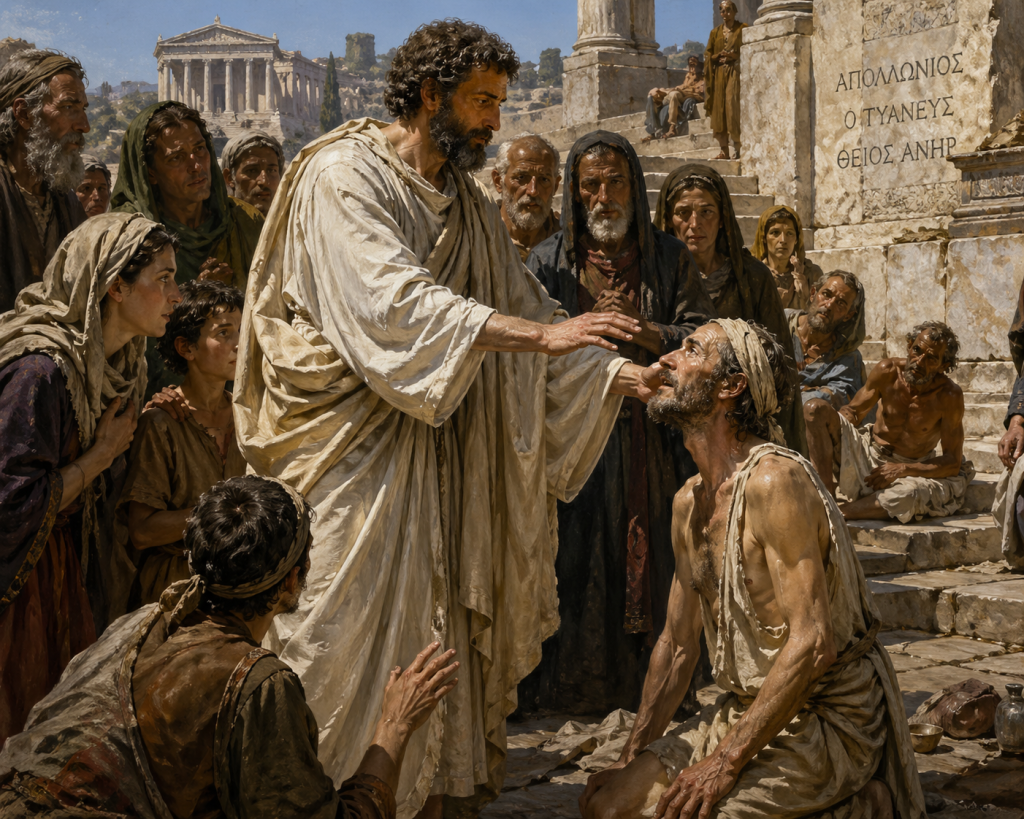
“He restored many who were afflicted, not by drugs or charms, but by words and presence.”
— Life of Apollonius of Tyana (paraphrased from multiple healing accounts, e.g., Books 1 & 3)
“The wise man heals the soul first, and through it the body.”
— Attributed teaching of Apollonius (Philostratus)
Apollonius Calling Disciples
Apollonius is described as attracting a group of dedicated followers who leave their ordinary lives to travel with him and adopt his teachings of discipline and self-mastery. His role is both teacher and guide, forming a community centered on philosophical transformation. A comparable pattern appears in the Gospel of Matthew, where Jesus calls individuals to follow him, and they respond immediately, leaving behind their previous occupations. In both cases, the act of following represents a decisive break from ordinary life, with commitment to the teacher forming the foundation of a lasting movement.
“Those who associated with him adopted his discipline and manner of life.”
— Life of Apollonius of Tyana 1.7
“He called men not to luxury, but to mastery of themselves.”
— Philostratus’
Apollonius Casting Out Demons
in Ephesus during a time of widespread fear and disease, where the cause of suffering is presented not as natural but as something hidden. In the narrative preserved by Philostratus, Apollonius identifies a seemingly ordinary beggar among the crowd as the source of the affliction, declaring that a demonic presence lies beneath the disguise. When the crowd acts and the figure is struck, the illusion is said to break, revealing the true nature of what had been concealed, and the plague comes to an end. The story frames Apollonius not as a healer in a conventional sense, but as one who perceives and confronts unseen forces directly.
“He bade them stone the beggar… and when they had done so, the demon was revealed.”
— Life of Apollonius of Tyana 4.10
Apollonius Appearing After Death
The end of Apollonius’ life is presented with ambiguity, including traditions that describe him appearing to followers after death, suggesting the continuation of the soul beyond physical existence. These appearances are framed as real encounters rather than symbolic memory. A similar claim is central to the narrative of Jesus in the Gospel of Luke, where he is described as appearing to his followers after execution, speaking with them and demonstrating physical presence. In both traditions, post-death appearances function to reinforce the authority and enduring significance of the figure beyond death itself.
“After his death, he appeared to a young man… showing that the soul is immortal.”
— Life of Apollonius of Tyana 8.31
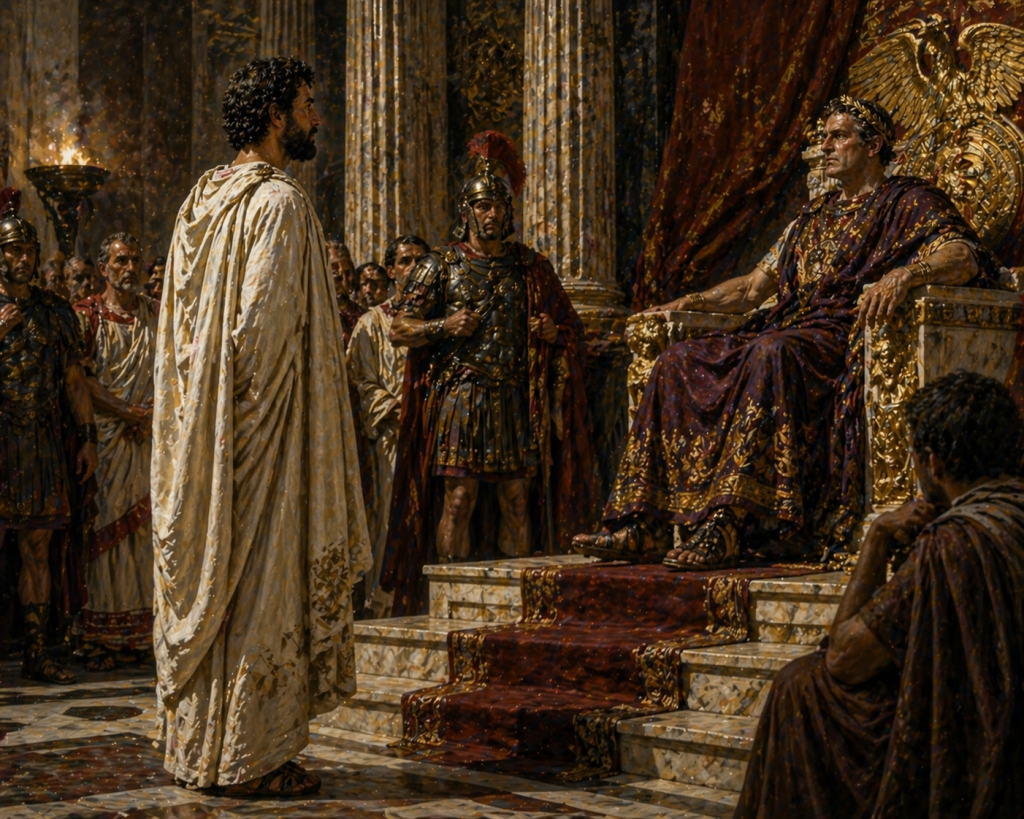
The Trial Before the Emperor
Apollonius stands before the Roman emperor Domitian.
He has been accused—of sorcery, of influencing people, of operating outside the bounds of acceptable order. The kind of charges often brought against men who gather followers and claim unusual authority.
He answers calmly—almost dismissively—as if the emperor’s authority does not fully apply to him.
“You may chain my body, but you cannot chain my soul.”
— Life of Apollonius of Tyana 8.7“No tyrant has power over the wise man.”
— Philosophical theme attributed to Apollonius
Two Lives Moving Through the Same World
Both men belong to the same broad era of the Roman Empire.
- Apollonius of Tyana, born in Tyana, travels across the empire—from Ephesus to Rome and beyond
- Jesus Christ, born in Bethlehem, teaches throughout Galilee, and ends in Jerusalem
One becomes a philosopher remembered in scattered texts.
The other becomes the center of a global faith.
Rebellion Over Biography: Why the Jesus Narrative Won
The survival of the Jesus story wasn’t due to better marketing; it was due to its function as a counter-cultural manifesto. While Apollonius remained a philosophical curiosity, the Jesus movement became a social wildfire that the Roman Empire eventually had to absorb just to stay standing.
1. Resistance vs. Biography
The story of Apollonius was a “top-down” project. Written by Philostratus for the Severan imperial family, it was a sophisticated literary work designed for the educated elite. It was a book you discussed in a library.
In contrast, the Jesus narrative was a “bottom-up” uprising. It emerged from a “wide network of communities” (the ekklesia) who weren’t just reading a story—they were living a rebellion. For the oppressed peasants and urban poor, this wasn’t an “already formed” narrative; it was a collaborative survival strategy. This communal ownership meant the story couldn’t be killed by burning a single scroll.
2. Hijacking the Imperial Brand
Early Christians engaged in a brilliant form of semiotic warfare, stealing the Empire’s most powerful symbols to strip them of their authority.
- Political Parody: By calling Jesus Kyrios (“Lord”) and his birth Euangelion (“Gospel”), they were opposing Roman propaganda. In the Roman mind, there was only one Lord (Caesar) and one Gospel (the peace established by Augustus). Proclaiming a Jewish carpenter with these titles was a direct, treasonous challenge to the Emperor’s divinity.
- Subverting Terror: Rome used crucifixion as a “public service announcement” to discourage rebellion. By taking the ultimate symbol of state-sponsored shame and making it a badge of cosmic victory, the movement robbed the Empire of its greatest psychological weapon: fear.
3. The Imperial Pivot: From Fire to Foundation
By the 4th century, the “grassroots fire” of the Jesus movement had become an uncontrollable political liability. The Empire realized that you cannot defeat a narrative that thrives on martyrdom.
Constantine’s “conversion” was a tactical pivot. By legalizing and eventually institutionalizing the faith, the Empire moved to quell the rebellion by making it the State. They traded a volatile, revolutionary movement for a structured, hierarchical Church.
- Standardization: Councils like Nicaea functioned to “correct” the many voices of the rebellion into a unified creed that was easier for an Empire to manage.
- The Co-opting of Power: The “Kingdom of God” was shifted from a rival political reality on Earth to a distant, spiritual realm, effectively neutralizing its immediate threat to the throne.
Surrendered to Christianity
Apollonius remained a respected account because he never challenged the structure of the world. Jesus became an unstoppable tradition because his followers created a community that functioned as a rival to the world. The Empire didn’t “choose” Christianity, the Empire surrendered to it.
But to fully understand why preservation priority one must understand about the Jewish War revolt against the Roman occupation that framed Christianity.
Sources:
- Philostratus, Life of Apollonius of Tyana, c. 220–230 CE.
- Apollonius of Tyana (attributed),Letters of Apollonius, 1st–2nd century CE (uncertain).
- Flavius Josephus, The Jewish War, c. 75 CE.
- Flavius Josephus, Antiquities of the Jews, c. 93 CE.
- Tacitus, Annals, c. 116 CE.
- Martin Goodman, The First Jewish Revolt, 2007.
- N. T. Wright, Jesus and the Victory of God, 1996.
- Richard A. Horsley & John S. Hanson, Bandits, Prophets, and Messiahs, 1985.
- E. P. Sanders, The Historical Figure of Jesus, 1993.
- John Dominic Crossan, The Historical Jesus: The Life of a Mediterranean Jewish Peasant, 1991.
- Paula Fredriksen, Jesus of Nazareth, King of the Jews, 1999.
- Warren Carter, The Roman Empire and the New Testament, 2006.