
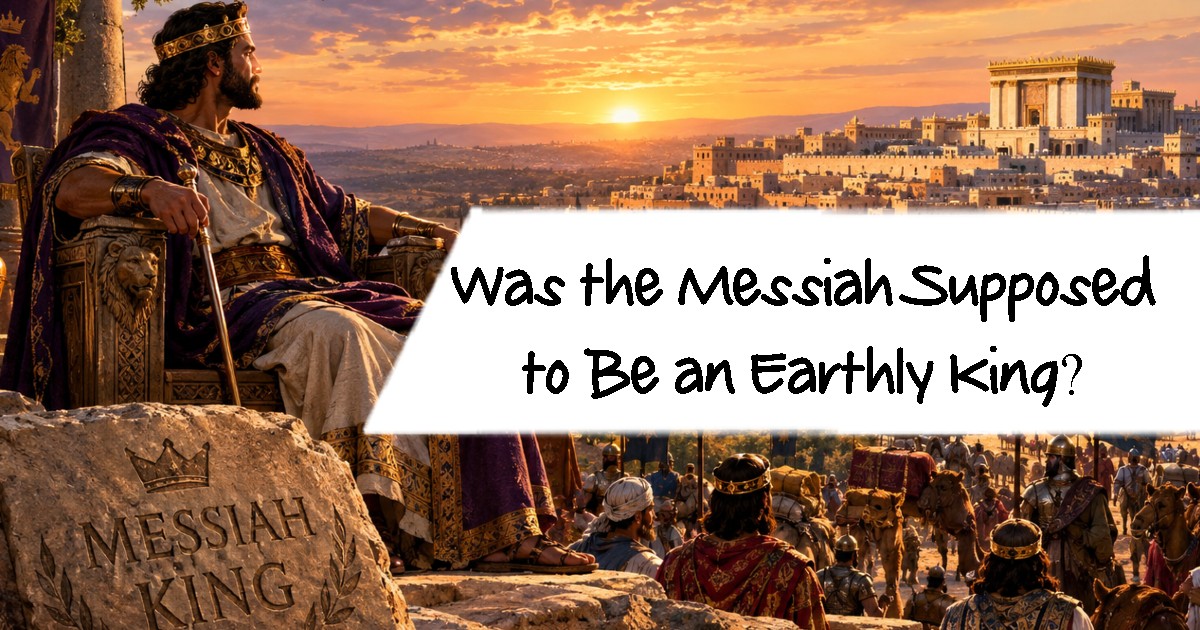
An Earthly Annoited Ruler
The word Messiah has become so thoroughly associated with Jesus that it is easy to forget how ordinary, and how political, the underlying concept originally was.
The Hebrew word is מָשִׁיחַ (māšîaḥ), derived from the verb מָשַׁח (māšaḥ), meaning “to anoint.” An anointed person was someone formally consecrated to an office. In the Hebrew Bible, that could mean a king, a priest, and in at least one famous case, the Persian ruler Cyrus. The Greek translation of māšîaḥ is χριστός (christos), from which we get “Christ.”
That etymology matters because the later Christian use of “Christ” can make it sound as though “Messiah” was originally a technical term meaning a divine savior who would die for humanity and take believers to heaven. That is not what the Hebrew word itself means.
In its older biblical setting, the māšîaḥ is fundamentally the anointed one. Most prominently, he is an anointed king.
And once the prophetic promises concerning David are examined together, a striking picture emerges: much of the Hebrew Bible’s future hope for Israel concerns a restored nation, its land, Jerusalem, and a Davidic ruler exercising kingship.
The question, then, is not whether later Jews and Christians developed more elaborate ideas about the Messiah. They certainly did. The historical question is what the earlier texts themselves appear to have promised.
The Messiah was not originally a name
English readers often encounter “Messiah” as though it were simply the ancient Hebrew equivalent of the name “Jesus.”
It was not.
Consider David’s reaction when he had the opportunity to kill Saul:
“The LORD forbid that I should stretch forth mine hand against my lord, for he is the LORD’S anointed.”
— 1 Samuel 26:11, KJV
The word translated “anointed” is from the same māšîaḥ word family.
Saul was not a heavenly savior. He was the earthly king of Israel.
David is described in the same royal terminology. Psalms repeatedly speak of God’s “anointed” in connection with the Davidic king.
The Hebrew terminology therefore began with a concrete political institution: a person installed into office through anointing.
That does not prove that every later use of “Messiah” meant merely “ordinary king.” Meanings develop. But it does tell us where the concept begins.
The Davidic covenant supplies the basic expectation
The most important text is arguably 2 Samuel 7.
David wants to build a temple. Instead, according to the story, God promises David something even more significant: a continuing dynasty.
God says:
“I will set up thy seed after thee, which shall proceed out of thy bowels, and I will establish his kingdom.”
— 2 Samuel 7:12
Then:
“He shall build an house for my name, and I will stablish the throne of his kingdom for ever.”
— 2 Samuel 7:13
And again:
“Thine house and thy kingdom shall be established for ever before thee: thy throne shall be established for ever.”
— 2 Samuel 7:16
The immediate referent is David’s royal dynasty, with Solomon as the next king. But the promise becomes enormously important for later messianic expectation.
Notice what is being promised.
It is not primarily a disembodied spiritual existence.
It is:
David → descendant → kingdom → throne → Israelite royal succession.
The basic image is political and terrestrial.
A future ruler sits on a throne associated with David’s kingdom.
The Psalms turn the Davidic king into God’s chosen ruler
Psalm 2 provides another important example.
It describes earthly rulers conspiring against:
“the LORD, and against his anointed”
The Hebrew here is מְשִׁיחוֹ (mešîḥô), “his anointed.”
God then declares:
“Yet have I set my king upon my holy hill of Zion.”
— Psalm 2:6
The king is associated with Zion, the political and religious center of Jerusalem.
Then comes the royal declaration:
“Thou art my Son; this day have I begotten thee.”
— Psalm 2:7
And the ruler is promised:
“Ask of me, and I shall give thee the heathen for thine inheritance, and the uttermost parts of the earth for thy possession.”
— Psalm 2:8
Whatever later Christian theology makes of Psalm 2, the original royal imagery is difficult to miss: a divinely appointed king, Zion, nations, territory, inheritance, and rule.
The imagery is not that of a modern conception of “going to heaven.”
It is kingship.
Jeremiah explicitly says that the future Davidic figure will reign as king
Jeremiah makes the expectation even more explicit.
“Behold, the days come, saith the LORD, that I will raise unto David a righteous Branch, and a King shall reign and prosper, and shall execute judgment and righteousness in the earth.”
— Jeremiah 23:5
The Hebrew phrase for “a righteous Branch” is צֶמַח צַדִּיק (ṣemaḥ ṣaddîq). “Branch” or “shoot” becomes an important metaphor for a future Davidic ruler.
But notice the verb immediately following it:
“a King shall reign.”
The passage continues:
“In his days Judah shall be saved, and Israel shall dwell safely.”
— Jeremiah 23:6
This is not abstract language.
It describes Judah, Israel, a king, and national security.
Jeremiah later makes the Davidic dimension even harder to miss:
“But they shall serve the LORD their God, and David their king, whom I will raise up unto them.”
— Jeremiah 30:9
That is remarkably concrete.
Israel will serve Yahweh. David will be their king.
And Jeremiah 33 says:
“I will cause the Branch of righteousness to grow up unto David; and he shall execute judgment and righteousness in the land.”
Then comes the statement:
“David shall never want a man to sit upon the throne of the house of Israel.”
— Jeremiah 33:15, 17
Whatever one ultimately concludes about the historical realization of these promises, their imagery is not ambiguous in one respect: the promise is framed in terms of earthly Israelite kingship.
Ezekiel’s restoration vision is even more explicit
Ezekiel 37 gives one of the clearest examples.
The prophet first describes the famous vision of dry bones being restored to life. The interpretation identifies the bones with Israel:
“Behold, O my people, I will open your graves, and cause you to come up out of your graves, and bring you into the land of Israel.”
— Ezekiel 37:12
The prophecy then turns to political reunification.
God says:
“I will make them one nation in the land upon the mountains of Israel; and one king shall be king to them all.”
— Ezekiel 37:22
Then:
“And David my servant shall be king over them; and they all shall have one shepherd.”
— Ezekiel 37:24
And finally:
“My servant David shall be their prince for ever.”
— Ezekiel 37:25
The sequence is extraordinary when read without later Christian assumptions:
Israel is restored to its land.
Israel becomes one nation.
Israel has one king.
That king is called David.
The text does not describe souls departing to heaven.
It describes Israel restored on earth under a Davidic ruler.
Zechariah’s king enters Jerusalem
Zechariah provides another famous royal prophecy:
“Rejoice greatly, O daughter of Zion; shout, O daughter of Jerusalem: behold, thy King cometh unto thee.”
— Zechariah 9:9
The king is riding a donkey.
Then the prophecy turns outward:
“His dominion shall be from sea even to sea, and from the river even to the ends of the earth.”
— Zechariah 9:10
The imagery is recognizably that of an ancient king entering a city and exercising dominion.
The same book later describes a climactic restoration centered on Jerusalem.
Zechariah 14 depicts nations attacking Jerusalem, Yahweh intervening, and Jerusalem surviving. Its conclusion states:
“And the LORD shall be king over all the earth.”
— Zechariah 14:9
Whatever symbolic interpretation one gives the chapter, its imagined geography is decidedly terrestrial: Jerusalem, Mount of Olives, nations, battle, water flowing from Jerusalem, and kingship over the earth.
Isaiah’s restored Israel rules in a world of nations
Isaiah 60 is particularly interesting because it supplies the kind of restoration imagery often overlooked when Christian discussions focus almost exclusively on heaven.
The chapter begins:
“Arise, shine; for thy light is come, and the glory of the LORD is risen upon thee.”
Zion becomes the center toward which nations and kings come:
“And the Gentiles shall come to thy light, and kings to the brightness of thy rising.”
The chapter describes foreign wealth flowing to Jerusalem and concludes with an extraordinarily blunt statement:
“For the nation and kingdom that will not serve thee shall perish.”
— Isaiah 60:12
This is the passage Justin DZ discusses in The Bible EXPLODED! Part 2.
The important point is not whether a modern believer accepts Isaiah’s prophecy. The point is what kind of future it imagines.
It imagines restored Zion at the center of an international political order.
Foreign kings come.
Nations serve.
Jerusalem is restored.
This is a picture of earthly restoration, not simply a promise that individual believers will someday leave earth.
“Messiah” and “Christ” are linguistic equivalents
The linguistic development from Hebrew to Greek reinforces the point.
Hebrew:
מָשִׁיחַ (māšîaḥ)
“anointed one”
Greek:
χριστός (christos)
“anointed one”
The Greek verb χρίω (chriō) means “to anoint.”
Thus Jesus Christ can literally be understood as Jesus the Anointed One.
“Christ” was therefore originally a title, not Jesus’ surname.
This is significant because Christian usage eventually turned the title into a highly specialized theological identity. In the New Testament, “Christ” becomes inseparable from Jesus and comes to encompass ideas of resurrection, divine sonship, universal salvation, exaltation and cosmic rule.
Those later meanings are important for understanding Christianity.
But they should not simply be projected backward onto every earlier occurrence of māšîaḥ.
The Hebrew Bible itself uses the word for kings, priests, Cyrus, and other consecrated figures.
The Persian king Cyrus was also called God’s “anointed”
Perhaps the best demonstration that “Messiah” was not inherently a supernatural title is found in Isaiah 45:1.
God says of Cyrus:
“Thus saith the LORD to his anointed, to Cyrus.”
The Hebrew is again לִמְשִׁיחוֹ (limšîḥô), “to his anointed.”
Cyrus was a Persian emperor.
He wasn’t an Israelite descendant of David.
He wasn’t a future heavenly redeemer.
He was a foreign monarch whom Isaiah presents as an instrument of Israel’s God.
This demonstrates something essential about the word:
“Anointed” describes an authorized ruler or agent. The later messianic concept grows out of that vocabulary; it is not the original lexical definition.
The Second Temple period shows that Jewish expectations were developing
This is where things become more complicated.
It would be wrong to replace one oversimplification with another and claim that every Jew in the centuries before Christianity expected exactly the same earthly Davidic king.
They did not.
Second Temple Judaism produced a remarkably diverse range of eschatological expectations.
Some texts emphasize a Davidic ruler.
Others emphasize priests.
Some envision an angelic or heavenly figure.
Some combine several figures.
The Dead Sea Scrolls are especially valuable because they show this diversity existed before Christianity.
The “Branch of David” at Qumran
One Qumran text commonly called 4QFlorilegium (4Q174) interprets 2 Samuel 7 and speaks of the future “Branch of David.”
It associates this Davidic figure with the “last days” and a future restoration centered on Zion. Scholarship generally regards this as an important pre-Christian example of 2 Samuel 7 being read in explicitly messianic terms.
In other words, the idea that David’s covenant pointed toward a future ruler was not invented by the New Testament writers.
It was already present within Second Temple Jewish interpretation.
And that matters enormously when evaluating claims about Jesus and the Messiah.
The Psalms of Solomon preserve a strongly political Davidic Messiah
The Psalms of Solomon, probably composed in the first century BCE, provide an especially useful comparison.
Psalm 17 looks forward to a righteous ruler from David’s line who will purge Jerusalem of sinners, gather the people, defeat foreign domination, and rule according to God’s will.
The scholarly discussion of this text commonly identifies its messianic figure as a Davidic king, while also emphasizing that Jewish messianic expectations were diverse rather than standardized.
That is important historical evidence.
Near the time of Jesus, at least one Jewish messianic tradition clearly anticipated something recognizably royal:
Davidic lineage + Jerusalem + restoration + defeat of foreign rule + righteous kingship.
That sounds much more like a Jewish restoration king than the later popular Christian image of a Messiah whose principal mission is simply to get people into heaven.
1 Maccabees shows how concrete Jewish political restoration remained
The books of the Maccabean period give us a useful historical window.
In 1 Maccabees 14, Simon is recognized as the permanent political and religious leader of the Jewish people:
“Simon should be their leader and high priest for ever”
The text describes him governing the country, commanding its military forces, controlling fortifications, and exercising authority over the sanctuary.
Simon wasn’t the expected Davidic Messiah, but the passage demonstrates something about Jewish political imagination in the period.
Kingship, national sovereignty, military independence, Jerusalem and the Temple were concrete categories of Jewish restoration.
The idea of a restored Jewish polity was not foreign to the period.
Then there is Daniel
Daniel complicates the picture.
Daniel 7 describes four beastly kingdoms and then introduces:
“one like the Son of man”
who comes:
“with the clouds of heaven”
and receives:
“dominion, and glory, and a kingdom, that all people, nations, and languages, should serve him.”
At first glance this sounds unmistakably heavenly.
And it is one reason it is dangerous to argue that every pre-Christian Jewish messianic hope was simply “an earthly king.”
Daniel is not that simple.
Scholars have offered different interpretations of the “one like a son of man.” Some interpret the figure as an individual heavenly being; others see the figure as representing the faithful people of Israel; still others understand the passage as combining individual and collective symbolism. Daniel 7 itself later explains the kingdom in terms of the “saints of the Most High” receiving dominion.
That diversity is historically important.
There was no single standardized “messianic job description.”
The Jewish world of the Second Temple period contained Davidic kings, priests, prophetic restorers, heavenly figures, angels, and apocalyptic agents.
1 Enoch goes even further toward heavenly imagery
The Parables of Enoch, contained in 1 Enoch 37–71, preserve another striking development.
The text describes a figure called the Son of Man, the Chosen One, and the Anointed One, who participates in eschatological judgment. Modern scholarship debates the precise date and development of these chapters, but the text demonstrates that Jewish messianic speculation could extend well beyond an ordinary earthly king.
Indeed, recent scholarship has examined the possibility that the Son of Man in these traditions is portrayed as preexistent, existing before creation.
That is dramatically different from the straightforward Davidic royal model of Jeremiah.
And that difference is precisely the point.
The Jewish concept of the expected deliverer developed.
It did not begin as one fully formed doctrine.
Even Daniel’s “Son of Man” does not erase the Israelite kingdom
There is another interesting feature of Daniel 7.
The heavenly vision ultimately ends with God’s kingdom being given to the holy ones:
“the saints of the most High shall take the kingdom, and possess the kingdom for ever.”
— Daniel 7:18
Later:
“the kingdom and dominion, and the greatness of the kingdoms under the whole heaven, shall be given to the people of the saints of the most High.”
— Daniel 7:27
Notice that phrase:
“under the whole heaven.”
The apocalyptic vision may use heavenly courtroom imagery, but its ultimate concern is the overthrow of earthly empires and the transfer of dominion.
Once again, heaven and earth interact.
The issue isn’t simply “earthly versus heavenly.”
The more historically accurate conclusion is that Jewish eschatology developed increasingly sophisticated ways of imagining God’s heavenly sovereignty becoming effective over the earthly world.
That is exactly why later Christianity had such fertile material from which to construct its own Christology.
The Christian reinterpretation
The New Testament doesn’t invent the Davidic promise.
Instead, it reinterprets it around Jesus.
Luke explicitly tells us:
“the Lord God shall give unto him the throne of his father David”
and:
“he shall reign over the house of Jacob for ever.”
— Luke 1:32–33
That is an extraordinarily revealing passage.
Luke knows the older Davidic promise.
His solution is to identify Jesus as its fulfillment.
The problem from a historical-critical perspective is straightforward:
Jesus did not sit on David’s throne in Jerusalem during his lifetime.
The Christian response is not usually to deny the Davidic promise. Instead, the promise is transformed.
Acts 2, for example, argues that David foresaw the resurrection and exaltation of the Messiah.
The promised king therefore becomes a king who has:
died → risen → ascended → been enthroned in heaven.
That is a creative theological solution.
But it is also an interpretive development.
“My kingdom is not of this world”
John’s Gospel gives us perhaps the clearest expression of a Christianized kingdom concept.
Jesus says:
“My kingdom is not of this world.”
— John 18:36
Whatever precisely John means by this, it sounds very different from the political restoration language of Jeremiah and Ezekiel.
Yet Christianity later combines this heavenly kingship with an eventual earthly return.
The result is a two-stage solution:
Jesus reigns from heaven now.
Jesus returns to earth later.
This allows Christians to preserve the old language of kingship while relocating its fulfillment into an explicitly Christian eschatological framework.
Revelation brings the two worlds back together
Interestingly, Revelation eventually reconnects heavenly and earthly themes.
The book describes heavenly visions, angels and divine judgment, but it ultimately presents a New Jerusalem descending from heaven.
That is not the same thing as human souls permanently leaving earth for heaven.
The climax is heaven coming down.
Revelation 21 says:
“And I John saw the holy city, new Jerusalem, coming down from God out of heaven”
The biblical story therefore ends not simply with people escaping earth but with a transformed creation.
This is one reason blanket statements such as “the Bible teaches that everyone ultimately goes to heaven” are historically inadequate.
That is a later popular formulation of a much more complicated biblical eschatology.
What did the Hebrew Bible actually promise?
The evidence points toward several overlapping traditions rather than one single messianic doctrine.
But the Davidic royal tradition is remarkably consistent.
The expected ruler is connected with:
David’s lineage.
He is associated with:
a throne.
He rules:
Israel.
His kingdom is connected with:
Jerusalem/Zion.
He exercises:
judgment and righteousness.
Israel experiences:
restoration and security.
Foreign nations are:
subdued, judged, or brought under God’s rule.
And the wider objective is:
the establishment of God’s righteous order on earth.
That is plainly more concrete and political than the modern popular idea of “Messiah” as simply “someone who saves you from hell.”
But there was never only one Jewish messiah
This qualification matters.
The historical evidence does not justify saying:
“Every Jew before Jesus expected a literal earthly Davidic king.”
Second Temple Jewish expectations were diverse.
Some texts emphasize a Davidic king.
Others expect a priestly Messiah.
Daniel offers the mysterious “one like a son of man.”
1 Enoch develops heavenly eschatological figures.
Qumran combines different messianic traditions.
Later Jewish and Christian texts continue developing these ideas in different directions.
The better conclusion is therefore not that Judaism had one universal messianic doctrine.
It is that the Davidic earthly king is one of the oldest and most deeply rooted strands of Israel’s royal restoration tradition, while Second Temple Judaism increasingly developed alternative heavenly and apocalyptic forms of messianic expectation.
The larger pattern
The development can be summarized like this:
Early Israelite kingship
Anointing identifies legitimate rulers.
Davidic covenant
God promises David an enduring dynasty and throne.
Prophetic restoration
Isaiah, Jeremiah, Ezekiel and Zechariah envision restoration, Davidic rule, Jerusalem and God’s victory over the nations.
Second Temple Judaism
These traditions diversify into Davidic, priestly and apocalyptic expectations.
Jesus movement
Jesus is proclaimed the Messiah despite not becoming an earthly king of Israel.
Christian reinterpretation
David’s throne becomes heavenly enthronement; resurrection becomes vindication; the kingdom becomes inaugurated but not yet complete.
Christian eschatology
Jesus ultimately returns and establishes God’s final kingdom.
That developmental history is more interesting than either extreme.
It isn’t necessary to claim that Christianity simply “made everything up.”
Nor is it necessary to assume that the later Christian interpretation is exactly what Jeremiah or Ezekiel originally meant.
The evidence supports a third possibility:
Ancient Jewish and Christian authors were engaged in an ongoing process of reinterpretation.
Conclusion: the Messiah began with a throne
The word Messiah means “anointed one.”
Its earliest and most important royal usage concerns an earthly ruler.
The Hebrew Bible’s Davidic promises repeatedly describe:
a descendant of David,
a throne,
a kingdom,
Israel,
Jerusalem,
restoration,
and rule over the nations.
The prophets do contain heavenly and apocalyptic imagery, and Second Temple Judaism develops increasingly complex expectations of heavenly agents and end-time figures. Daniel and 1 Enoch demonstrate that clearly.
But none of that changes the basic fact that the Davidic messianic tradition is rooted in Israelite kingship.
The later Christian claim that Jesus is this Messiah therefore required more than simply finding his name hidden in ancient prophecy.
It required an interpretation:
David’s earthly throne became Jesus’ heavenly enthronement.
Israel’s restoration became the church’s incorporation into God’s people.
The promised kingdom became something inaugurated spiritually and completed in the future.
Whether one regards that as divine revelation or theological reinterpretation depends largely on one’s prior assumptions.
But historically, the distinction matters.
The Hebrew Bible did not begin with the Christian concept of a Messiah who dies for sins, rises from the dead, ascends to heaven, and saves individual believers from eternal punishment.
It began with a much older and more tangible idea:
an anointed ruler.
And in the Davidic tradition, that ruler was supposed to reign as king.
Scholarly Studies on the Messiah as an Earthly King
- Kenneth Atkinson, “On the Herodian Origin of Militant Davidic Messianism at Qumran: New Light from Psalm of Solomon 17”, Journal of Biblical Literature 118.3 (1999): 435–460. (SciSpace)
- Nathan C. Johnson, “Rendering David a Servant in Psalm of Solomon 17.21”, Journal for the Study of the Pseudepigrapha 26.3 (2017): 235–250. (Sage Journals)
- Brad Embry, “The Psalms of Solomon and the New Testament: Intertextuality and the Need for a Re-Evaluation”, Journal for the Study of the Pseudepigrapha 13.2 (2002). (Sage Journals)
- Daniel D. Martin, “The Davidic Messiah in the Old Testament: Tracing a Theological Trajectory”, Perichoresis 20.5 (2022): 87–96. Open-access version. (ResearchGate)
- Keun-Jo Ahn, “Messiah in the Old Testament: From the Son of David to the Son of God”, Korean Journal of Old Testament Studies 30.1 (2024): 166–208. (Korea Journal Central)
- Daehoon Kang, “Jewish Messianism in Second Temple Judaism”, New Testament Research 14.3 (2015): 311–340. (KCI)
- Maicol A. Cortés, “The Messianic Davidic Expectations of Psalms 151A and 151B, and Their Theology”, TheoRhēma 17.2 (2022): 5–17. (ResearchGate)
What These Studies Contribute
The scholarly evidence strongly supports the conclusion that the Messiah was expected to be an earthly king who would rule Israel. This expectation grows directly out of the Hebrew Bible’s Davidic kingship tradition and continues into Jewish writings from the Second Temple period.
Kenneth Atkinson’s study of Psalms of Solomon 17 is especially important. He identifies the text as evidence for pre-Christian Davidic messianism and shows how Jewish hopes developed for a powerful Davidic ruler in response to foreign domination of Judea. The Messiah is presented as a political and national ruler, not simply as a supernatural being. (SciSpace)
Nathan Johnson likewise examines Psalms of Solomon 17:21, one of the clearest early descriptions of the expected Messiah. The passage asks God to:
“raise up for them their king, the son of David, to reign over Israel.”
That is about as explicit as possible: the expected Messiah was a king, descended from David, and ruling over Israel. (Sage Journals)
The rest of Psalms of Solomon 17 describes this king cleansing Jerusalem, gathering Israel, defeating Israel’s enemies, and ruling the nations. This is an earthly kingdom centered on Israel and Jerusalem.
Daniel Martin traces this expectation back into the Hebrew Bible itself. He identifies the Davidic Messiah as a continuing royal and eschatological tradition rooted in the promise to David and developed by the prophets. The idea therefore did not originate with Christianity. It grew out of the older Israelite concept of Davidic kingship and an enduring throne. (ResearchGate)
Brad Embry also warns against reading earlier Jewish messianic texts through later Christian ideas. This is important because the original Jewish meaning of the Messiah should not be rewritten to match the later Christian concept of Christ. Psalms of Solomon 17 describes its Messiah in unmistakably royal, political, national, and earthly terms. (Sage Journals)
The Qumran text 4QFlorilegium (4Q174) provides additional pre-Christian evidence. It interprets the promise to David in 2 Samuel 7 in connection with a future “Branch of David.” Once again, the Davidic promise is being read as pointing toward a future ruler.
There were certainly other Jewish ideas about end-time figures. Daniel and 1 Enoch contain highly exalted and heavenly imagery, and some Jewish groups expected priestly or apocalyptic figures as well. But these developments do not erase the older and explicit Davidic expectation of an earthly king over Israel.
The important point is that the Messiah did not originally mean “a heavenly savior who takes people to heaven.” The word māšîaḥ means “anointed one,” and its most important biblical use is for kings. The Davidic Messiah therefore emerged from the institution of Israelite kingship.
The evidence from the Hebrew Bible and Second Temple Judaism makes the basic expectation clear:
The Messiah was expected to be a Davidic king who would restore Israel, rule from Jerusalem, defeat its enemies, and establish righteous rule over the earth.
Later Jewish and Christian traditions expanded this expectation in different directions. But the earthly Davidic king is the historical foundation of the messianic idea, not a secondary Christian invention.
Further Reading: The Messiah as an Earthly King
Several non-biblical sources from the Second Temple and early Roman periods provide useful evidence for how Jewish ideas of the Messiah and Israel’s future ruler developed. They do not present a single, uniform messianic doctrine, but some preserve a distinctly royal, national, and earthly expectation.
- Psalms of Solomon 17 is one of the clearest examples. Its future deliverer is explicitly connected with David, is portrayed as a righteous king, purges Jerusalem, gathers Israel, and exercises authority over the nations. The text presents the messianic hope in terms of restored Israel, Jerusalem, political rule, and Davidic kingship, rather than individual salvation in heaven.
- 4QFlorilegium (4Q174) from Qumran interprets the promise to David in 2 Samuel 7 in an eschatological context and refers to the future “Branch of David.” It is particularly valuable because it demonstrates that a Davidic messianic interpretation of Israel’s royal traditions existed before Christianity.
- Josephus, writing in the late first century CE, records several Jewish traditions involving expectations of rulers and deliverers associated with ancient prophecy. His discussion of the Jewish War also shows how claims surrounding royal or messianic leadership could have concrete political consequences in first-century Judea. Josephus’ account is especially useful for placing messianic expectation within the volatile political world of Roman-occupied Israel.
- Philo of Alexandria provides an important first-century Jewish comparison because his writings preserve Jewish interpretations of kingship, divine rule, and Israel’s restoration while demonstrating that Jewish theological thought was already capable of combining earthly political imagery with heavenly/divine concepts. Philo therefore helps illustrate why “earthly versus heavenly” is better understood as a development within Jewish thought than as a simple either/or distinction.
- 1 Enoch 37–71 provides an important counterpoint to the Davidic royal tradition. Its Son of Man or Chosen One is presented in highly exalted and apparently heavenly terms. This demonstrates that by the Second Temple period, Jewish expectations could extend beyond an ordinary earthly monarch to heavenly and apocalyptic figures. The diversity of these traditions cautions against claiming that every Jew expected only an earthly Davidic king.
- Daniel 7, although part of the biblical corpus, is especially relevant to comparison with these later works. Its “one like a son of man” receives universal dominion in a heavenly vision. The passage helps explain how Jewish expectations could develop from traditional Davidic kingship toward more cosmic and heavenly concepts of eschatological rule.
Taken together, these sources suggest a development rather than a single original doctrine: an older Israelite tradition of anointed and Davidic kingship provided the foundation, while Second Temple Judaism expanded that tradition into multiple competing models, including the earthly Davidic king, the priestly Messiah, and the heavenly/apocalyptic Son of Man. The historical question is therefore not whether an earthly Messiah was the only Jewish expectation, but how and why the meaning of the expected ruler changed across time.
Sources:
- Flavius Josephus, Antiquities of the Jews, c. 93–94 CE.
- Josephus, The Jewish War, c. 75–79 CE.
- Josephus, Against Apion, c. 93–96 CE.
- Philo of Alexandria, On Rewards and Punishments, 1st century CE.
- Philo of Alexandria, On the Embassy to Gaius, c. 41–50 CE.
- Psalms of Solomon, Psalms of Solomon 17, 1st century BCE.
- 4QFlorilegium (4Q174), Qumran fragment, 1st century BCE.
- 1 Enoch, The Similitudes of Enoch (1 Enoch 37–71), date disputed, commonly placed in the late Second Temple period.
- Daniel, Daniel 7, 2nd century BCE in its final form.